
-
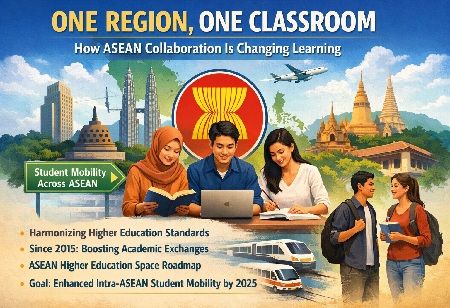
In a bold move to transform the educational landscape of Southeast Asia, ASEAN is charting a path toward a truly integrated academic community one that celebrates both diversity and solidarity. Since 2015, member states have pledged to harmonize higher education standards, making the exchange of students and scholars across borders not just possible, but routine. The ASEAN Higher Education Space roadmap (2022) and the Master Plan on ASEAN Connectivity (MPAC) envision a future where intra-ASEAN student mobility soars to unprecedented heights by 2025.
Central to this vision are innovative strategies: a common credit-transfer system, unified qualifications frameworks, and the tantalizing prospect of an ‘ASEAN Branded Scholarship’ to make regional study accessible to all. On the ground, universities are weaving a network of collaboration through the ASEAN University Network (AUN) and its specialized arms Quality Assurance, Innovation, and more aligning curricula, fostering joint programs, and slowly dissolving the boundaries that once divided their campuses. The dream is clear: a region where knowledge flows freely and students navigate Southeast Asia as seamlessly as their own neighborhoods, supported by ASEAN education collaboration initiatives and cross-border education programs.
Regional Cooperation Models
Since its establishment in 1995, the ASEAN University Network (AUN) has emerged as a fundamental pillar of regional collaboration, consisting of 30 leading universities across all ten member countries. Fundamentally, AUN seeks to ‘harmonize educational standards and seek continuous improvement’ across higher education institutions within the region. To achieve this, AUN has created thematic networks on quality assurance, entrepreneurship, and credit transfer to foster joint initiatives and collaboration, supporting ASEAN higher education partnerships across Southeast Asia.
AUN has achieved a number of milestones, one being the establishment of the ASEAN Credit Transfer System (ACTS), which seeks to address a long-standing problem of differing grading scales and credit systems. ACTS has created a standardized system that includes grading scales, an online course catalog, and a unified application system to enable cross-border studies, ensuring that students can undertake studies abroad and still have their credits counted when they return home. The University Innovation & Enterprise network, also known as AUN-UIE, has brought universities and industry partners together to enable knowledge sharing, cross-border research, and entrepreneurship education.
Through these platforms, faculty members can co-supervise theses across countries, share research, and co-develop curricula under agreed ASEAN standards, aligning with international curriculum development and collaborative teaching models in Southeast Asia classrooms. Together with broader frameworks like the ASEAN Work Plans on Education and the Master Plan on ASEAN Connectivity (MPAC), these networks are steadily dismantling policy and administrative barriers, transforming ASEAN universities into a single, interconnected campus.
Also Read: 10 Parenting Strategies for Gen Alpha in Asia's Over-Stimulated Era
Student Mobility & Cross-Border Learning
For students, this represents unprecedented opportunities to study, live, and work in other countries in the region. Scholarship programs, both national and bearing the ASEAN brand, along with international student exchange programs Asia, allow students to have a first-hand experience in partner universities in other countries in the region. Malaysia, for example, launched its 2025 ASEAN Student Mobility Program, which brought together 500 students through online forums and short on-campus visits in 13 universities in Malaysia, where students were immersed in issues relating to ASEAN and its rich cultural diversity.
Studies have found that this phenomenon has a tangible effect on students, with those who have undergone the ASEAN International Mobility for Students (AIMS) program showing significant improvements in their academic, intercultural, and language capabilities. By studying in other countries in the region, students are able to hone their adaptability and multiculturalism in a globalized economy, which ASEAN leaders see as a key capability in a globalized economy.
Each year, intra-regional mobility in ASEAN is on the increase, with scholarships, credit transfers, and online portals supporting this trend.
- Credit and Transfer Initiatives: The AUN-ACTS portal, managed by Universitas Indonesia, allows students to browse courses across dozens of ASEAN universities and seamlessly apply for credit transfers. Workloads are converted under a uniform system, making cross-border study straightforward.
- Joint Programs: Several ASEAN universities now offer dual- or joint-degree programs. For example, Universitas Gadjah Mada (Indonesia) and the University of Agder (Norway) co-lead an ASEAN Master in Sustainability Management, a two-year, full-scholarship program where students earn an MBA from UGM and an MSc from UiA. Indonesia’s Institut Teknologi Bandung (ITB) also offers an ASEAN MBA in partnership with Universiti Sains Malaysia, with faculty and coursework shared between the two institutions. Students engage with transnational case studies and participate in company visits across Southeast Asia, reflecting truly transnational education models.
- Cultural Exchange: Exchange programs go beyond academics, often including home-stays, language partnerships, and campus-life immersion. AUN also organizes summer camps and youth forums, such as the ASEAN+3 Youth Cultural Forum, mixing students from 10+ countries to cultivate mutual understanding and strengthen regional identity.
Thanks to policy support including easier visa rules under MPAC 2025, standardized credit recognition through ACTS, and expanded scholarship opportunities ASEAN students are increasingly taking advantage of cross-border learning. Surveys consistently show that students value not only the academic gains but also the intercultural skills and ASEAN perspective they acquire, enhancing both personal growth and regional employability.
Joint Programs & Curriculum Integration
In addition to student mobility, ASEAN universities are also increasingly co-creating curricula with no borders. Apart from ACTS, some networks are also working on co-created curricula. For instance, the Quality Assurance Network of AUN (AUN-QA) is working on the development of guidelines to ensure that courses approved in one country can easily be approved in other ASEAN countries. Collaborative Online International Learning (COIL) is also being piloted, which enables the co-teaching or joint participation of students from different countries through video conferencing. ASEAN’s roadmap also talks about the development of fully functional Virtual Exchange and the ASEAN Credit Transfer System by 2025.
Real-world examples serve to illustrate this integration in action. The UGM Agder Master’s program, previously mentioned, is a case in point where business studies in Indonesia are supplemented by strategy and internship studies in Norway, culminating in a shared thesis project. Bachelor programs are also increasingly offering the opportunity for students to gain half of their credits in another country via jointly developed tracks. In reality, classrooms in Bangkok, Manila, and Jakarta are slowly becoming a shared space.
Also Read: Promising Education Policy Practices for Access & Safety in Asia
Benefits for Universities and Faculty
The ASEAN integration is a significant advantage for universities and faculty members in several ways. Universities can engage in massive research activities in the region by pooling their resources, and thematic networks in AUN encourage interdisciplinary collaboration in innovation, enterprise, and knowledge sharing activities. Faculty members can co-author research papers with colleagues from other countries, and joint PhD supervision is becoming a trend.
The quality assurance activities in ASEAN universities are another advantage in maintaining high standards in these institutions. Hundreds of programs have been peer-reviewed by AUN-QA, and these programs are consistent in quality in terms of international standards. It not only helps in international promotion but also ensures that degrees earned in these universities are recognized in ASEAN countries. For instance, in the 2024 edition of THE Impact Rankings, several AUN-affiliated universities in Singapore, Malaysia, and Thailand dominated the top positions in various categories. Universities can benefit from accreditation, faculty exchange programs, and visiting professors in establishing their global brand.
Practical outcomes are visible: Singapore hosts branch campuses from 16 international institutions, while Malaysia’s EduCity Iskandar campus houses four foreign universities. Such regional presence strengthens every member’s international visibility and reputation.
Challenges & Barriers
Yet, challenges remain. Accreditation and curriculum alignment processes remain fragmented, with different credit structures, grading standards, and degrees in each country. Although the ACTS and agreements such as the Bangkok Accord offer a starting point, the level of compliance is uneven, especially outside Singapore and Malaysia. Another challenge is the language barrier. While the proficiency level is high in Malaysia, it is low in the remaining CLMV countries (Cambodia, Laos, Myanmar, and Vietnam). As a consequence, the number of international students is minimal compared to Malaysia.
Other social and logistical challenges remain. Universities may not all have the infrastructure and the means to support the program, which is to the disadvantage of smaller universities. Furthermore, the transfer of credits can be complex. Moreover, the flow of students can cause brain drain, which is beneficial to larger universities while smaller ones suffer with fewer students. Policy dialogues in ASEAN address the challenges.
Conclusion
The vision of ASEAN is to have a fully integrated space for higher education by 2025, which will include a digital credit system and scholarships. Singapore and Malaysia are already becoming education hubs. Various initiatives, such as EduCity Iskandar, have already started. When looking ahead to 2026 and beyond, there are going to be new opportunities for education through virtual learning. There will also be credit unions and competency-based degrees that allow for degrees in multiple countries. ASEAN has a vision for 2045, which is to connect education to economic integration. ASEAN wants to have a skilled, adaptable workforce and to become a competitive, unified, and resilient global knowledge and innovation hub.
🍪 Do you like Cookies?
We use cookies to ensure you get the best experience on our website. Read more...