
-
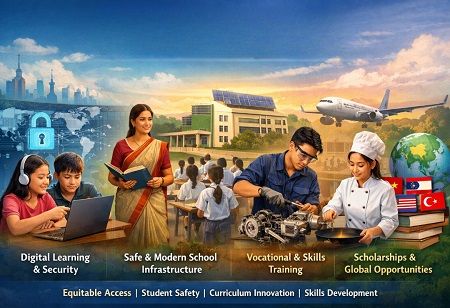
Education in Asia has long been a dynamic and evolving sector, shaped by the region’s rich cultural diversity, rapid economic growth, and technological innovation. In recent years, policymakers have concentrated on three interrelated priorities: expanding equitable access, safeguarding students, and addressing evolving learning needs through curriculum reform, infrastructure investment, and skills development. Across the continent, governments and institutions are implementing innovative, often interconnected strategies that combine technology, international collaboration, and flexible pedagogical approaches. From digital learning adaptations in response to security and environmental challenges to the expansion of scholarships and vocational programs, these initiatives reflect a sophisticated, holistic vision of education. Let’s dive into the articles that give a clear gist of these developments.
Prioritizing Safety amid Learning Disruptions
Safety has become a central concern for educational authorities, particularly in regions facing security or environmental challenges. For instance, in the United Arab Emirates (UAE), schools transitioned to online learning due to emerging security concerns. This proactive shift ensured that students continued their education uninterrupted while prioritizing their physical safety. Similarly, the UAE also announced an early spring break for schools and universities, adjusting academic calendars to respond to contextual safety concerns. These measures illustrate a growing recognition that student safety and learning continuity are inseparable.
In addition, India’s Central Board of Secondary Education (CBSE) postponed the March 2 board exams for students in the Middle East. By adjusting examination schedules, authorities aimed to reduce stress and guarantee fairness for students impacted by regional disruptions. Policies such as these highlight a shift toward flexible educational planning, ensuring that external events do not compromise academic progress or student well-being.
Key Takeaway: Prioritizing safety while maintaining learning ensures education resilience during crises.
Expanding Opportunities for Educational Access
Access to education remains a pressing policy challenge in Asia, with governments exploring both financial and structural interventions. In Malaysia, discussions are underway to expand the Perbadanan Tabung Pendidikan Tinggi Nasional (PTPTN) loans to private universities. This proposed measure would make higher education more accessible, enabling students from diverse socioeconomic backgrounds to pursue advanced studies in both public and private institutions.
Furthermore, cross-border collaborations also enhance access through international student mobility programs. For example, IIT Guwahati in India has strengthened its research and student exchange initiatives with Japanese institutions. Such programs broaden academic exposure, providing students with access to global networks, research facilities, and diverse learning environments. By removing geographical barriers, these policies contribute to a more inclusive and internationally connected education system.
Key Takeaway: Broadening access, including financial and international opportunities, creates inclusive and globally connected education.
Also Read: 10 Parenting Strategies for Gen Alpha in Asia's Over-Stimulated Era
Preparing Students for Future Careers
Adapting curricula to meet contemporary student needs is another crucial policy area. Many Asian countries are integrating skills development, technology, and emerging industries into their education systems. The Philippine Department of Education (DepEd) expanded its Korean language program, equipping students with valuable linguistic and cross-cultural competencies. Similarly, in Indonesia, Vice President Gibran explored IoT (Internet of Things) education in Bandung schools, exposing students to advanced technologies and fostering digital literacy from an early stage.
Beyond language and technology, Singapore has launched a large-scale AI skills training program, targeting 100,000 workers. By equipping students and the workforce with AI competencies, Singapore is preparing learners for the demands of an AI-driven economy. This approach underscores the importance of aligning curriculum policy with future-ready skills, ensuring students can participate meaningfully in high-tech industries.
Other initiatives emphasize vocational and applied learning, tailored to specific sectors. In South Korea, the launch of the first Biohealth Vocational High School in Daejeon provides specialized training in healthcare and biotechnology. Meanwhile, in Indonesia, collaboration between Danone and IPB University offers nutrition students an internship program, blending academic knowledge with practical industry experience. These efforts reflect a shift toward career-oriented education, enabling students to acquire skills directly applicable to employment and emerging markets.
Key Takeaway: Aligning curricula with future-ready skills equips students for evolving industries and technologies.
Driving Innovation through Educational Technology
Technology and innovation are transforming education delivery across Asia. In Thailand, EdTech startup RevisionSuccess joined Singapore Management University’s BIG Incubation Program, signaling growing support for education technology solutions. By fostering innovation in teaching and learning, EdTech initiatives enhance student engagement, personalize learning experiences, and address diverse learning needs.
Similarly, the establishment of HM Hospitals and Huawei’s Global Smart Healthcare Hub provides students with access to cutting-edge technology and hands-on learning in healthcare. Such collaborations between academia and industry exemplify policy-driven integration of education and technology, ensuring students gain practical, future-oriented competencies.
Key Takeaway: Integrating technology and fostering innovation enhances engagement and practical learning.
Also Read: Asia's Leadership in Empowering Cross-Border Education & Talent
Fostering Civic & Ethical Awareness
Education policies in Asia are increasingly attentive to civic and ethical development. In Thailand, civil groups launched an online course on Taiwan’s democracy, enhancing political literacy and critical thinking among students. Ethical considerations are further emphasized in higher education: National University of Singapore (NUS) launched a fellowship to advance healthcare ethics, equipping students with the skills to navigate moral dilemmas in healthcare settings.
These initiatives highlight that education is not solely about technical knowledge; it is also about preparing responsible, thoughtful citizens and professionals. By integrating ethics, civics, and societal awareness into learning, policymakers are addressing the broader developmental needs of students.
Key Takeaway: Incorporating ethics and civic learning develops responsible, thoughtful citizens and professionals.
Enhancing Learning through Improved Infrastructure
Physical infrastructure continues to play a vital role in creating supportive learning environments. Temple University Japan recently opened a new Hillside Center, providing improved spaces for student engagement, resources, and holistic development. Infrastructure investment supports not only academic success but also social, cultural, and personal growth, ensuring that learning extends beyond the classroom.
Infrastructure development complements other access-focused policies, creating an environment where students feel supported, safe, and empowered to achieve their academic and personal potential.
Key Takeaway: Investing in supportive facilities strengthens holistic student growth and engagement.
Advancing Education through STEM Opportunities
Investment in science, technology, engineering, and mathematics (STEM) education is central to many Asian education policies. The Philippine Space Agency (PhilSA) promoted advanced space scholarships at UPLB, encouraging students to pursue careers in space science. By highlighting research opportunities and specialized scholarships, policymakers aim to stimulate interest in high-demand fields and foster innovation-driven economies.
STEM-focused initiatives also extend internationally. By strengthening collaborations between institutions like IIT Guwahati and Japanese universities, students gain exposure to cutting-edge research, global methodologies, and cross-cultural academic networks. Such programs cultivate a generation of researchers and innovators equipped to tackle regional and global challenges.
Key Takeaway: Focusing on STEM and research prepares students for scientific leadership and global challenges.
Conclusion
Across Asia, education policies are evolving to balance access, safety, and student needs. From online learning in the UAE to AI training in Singapore, initiatives are increasingly student-centered, technology-integrated, and globally connected. Education is seen not just as a pathway to employment but as a holistic process encompassing safety, skills development, civic literacy, and ethics. Policymakers use adaptive strategies: postponing exams, expanding financial access, fostering vocational and STEM education, and leveraging technology. By aligning safety, access, and curriculum innovations, Asian countries set global benchmarks, preparing students for academic success, practical experience, and ethical leadership in a complex, rapidly changing world.
🍪 Do you like Cookies?
We use cookies to ensure you get the best experience on our website. Read more...