
-
- Real-world work is embedded in Hong Kong's education, from primary to secondary school.
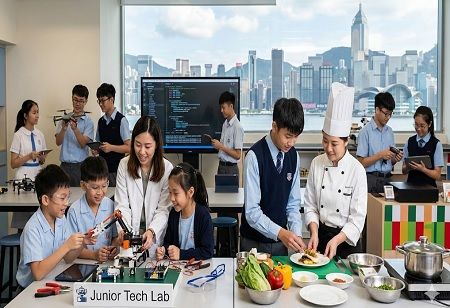
- Initiatives like BSPP and Applied Learning provide hands-on experience in fields like AI and hospitality.
- Hong Kong is enhancing work integration with programs like Easter internships and international school collaboration by 2030.
Hong Kong stands at the threshold of a transformative era in education. Amidst the city's bustling skyline and relentless drive for innovation, a quiet revolution is underway, the seamless weaving of real-world work experience into the fabric of primary and secondary schooling. This isn't just about ticking boxes for resumes, it's about equipping young minds with the tools to navigate a hyper-competitive global economy.
In a place where academic pressure has long dominated, Hong Kong's Education Bureau (EDB) is shifting gears, fostering ‘life-wide learning’ that bridges classrooms and careers. Drawing from official initiatives and recent pilots, this approach promises to cultivate resilient, career-ready citizens starting from the playground.
From Academic Rigor to Real-World Readiness
Hong Kong's education system, renowned for its high-stakes exams like the Diploma of Secondary Education (DSE), has historically prioritized rote learning. But reforms since the early 2000s have signaled change.
The 2009 extension of free education to 12 years emphasized diversified curricula, including experiential elements. 2014, the EDB launched Career and Life Planning Education (CLPE), mandating schools to help students explore aspirations through practical exposure. This evolved from earlier pilots like the Business-School Partnership Programme (BSPP), introduced in 2005, which partners schools with over 300 businesses to offer internships and mentorships.
What sets Hong Kong apart is its holistic integration.
Unlike systems where work experience is an add-on, here it's embedded in the curriculum via ‘Other Learning Experiences’ (OLE). Primary students dip their toes through community visits, while secondary learners dive deeper with job shadowing.
As per EDB guidelines, this fosters self-understanding and career management skills, aligning with the city's push to become a regional innovation hub, as outlined in the 2025 Policy Address.
Hands-On Pathways for Every Student
At the heart of this integration are targeted programs that make work experience accessible and meaningful. The BSPP, now in its third decade, exemplifies collaboration.
In 2025/26, it rolled out ‘Greater Bay Area Career Exploration Tours’, allowing secondary students to visit tech firms in Shenzhen and Guangzhou, gaining insights into fintech and AI.
Over 5,000 students participated last year, with activities like simulated boardroom sessions and factory tours. For primary levels, BSPP offers lighter touches, such as school talks by professionals, sparking early curiosity.
Then there's Applied Learning (ApL), elective courses for senior secondary students covering 40+ fields like hospitality and engineering. These blend theory with practice think apprenticeships in hotels or coding labs with industry partners.
A 2023 study by the Asian Institute of Research highlighted ApL's role in bridging vocational and general education, with enrollment rising 15 percent annually. Programs like CLAP-TECH, an adaptation of the global P-TECH model, focus on IT: students in Forms 4-6 undertake paid internships, earning credits toward graduation. Evaluations show participants gain 20 percent more confidence in industry knowledge.
For broader reach, the EDB's Life-Wide Learning framework encourages career-related experiences from primary onward.
Initiatives like the Hong Kong Benchmarks for Career and Life Development (HKBM) Pilot, launched in 2021 under CLAP@JC, set standards for non-engaged youth but extend to schools.
In 2025, it emphasized progressive outcomes, primary kids learn basic job roles via role-play, while secondary students tackle real projects, like designing apps with startups.
Holiday programs add flexibility.
The 2026 Easter Work Experience slots, announced in February, offer two-week placements in sectors like finance and biotech, subsidized for needy students. The Vocational Training Council (VTC) complements this, providing free courses for Secondary 3 leavers, including hands-on training in emerging fields like digital media.
Challenges and Horizons
Yet, hurdles remain. Logistical issues, like timetabling internships, echo UK Diploma program pitfalls from the 2000s. Equity is key subsidies ensure access for low-income families, but scaling to all 500+ secondary schools demands more partnerships.
Looking ahead, 2026 brings promise. The EDB's blueprint for international schools and STEM push will amplify work integration.
Programs like HYAB Youth Start-up Internships offer 200 spots in AI and biotech, fostering entrepreneurship.
As Chief Executive John Lee envisions Hong Kong as an education hub, these initiatives could model sustainable, career-oriented learning globally.
In Essence!
Hong Kong's strategy isn't revolutionary it's evolutionary, organically blending tradition with innovation. By 2030, expect a generation not just educated, but empowered.
We're not preparing for jobs, we're building navigators for life's wilderness.
🍪 Do you like Cookies?
We use cookies to ensure you get the best experience on our website. Read more...