
-
Arizona Western College is expanding its international reach with new partnerships aimed at giving students from Yuma and surrounding communities direct access to some of the world’s leading semiconductor and technology education programs in Taiwan.
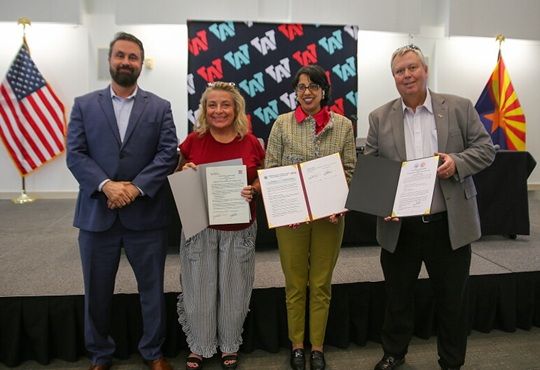
At a shared international press conference on Wednesday, the college announced that it had signed memoranda of understanding with three Taiwanese institutions: Asia University, Lunghwa University of Science and Technology, and National Kaohsiung University of Science and Technology. The agreements open the door to student and faculty exchanges, joint academic activities and new pathways for AWC students to gain international learning and professional experience, particularly in semiconductor manufacturing, engineering and artificial intelligence.
College leaders say the partnerships are designed to ensure that geography does not limit opportunity for students in rural southwestern Arizona. “Geography is not going to get in the way of opportunity,” said Dr. Shadi Kilani, executive vice president of AWC’s Entrepreneurial College. “The future of technology should be inclusive of our students from Yuma, San Luis, Somerton, Parker, Quartzsite, Wellton and every community across La Paz and Yuma counties.”
Kilani stressed that the collaboration is about more than technical skills. “This work is also more than just about technology; it’s about people. It’s about helping students build relationships, understanding other cultures and see that innovation is strongest when it’s grounded in human connection.”
The Taiwanese partners outlined the concrete opportunities they hope the agreements will create. Dr. Jeffrey J.P. Tsai, president and chair professor of bioinformatics and medical engineering at Asia University, said the university has developed a strong semiconductor education program for more than 15 years and maintains close working relationships with major industry players including Taiwan Semiconductor Manufacturing Company (TSMC), Siliconware Precision Industries (SPIL) and Micron. “We hope to develop students and faculty exchanges, joint academic activities and new pathways for students to gain international learning and professional experience in Taiwan, particularly at Asia University,” Tsai said.
National Kaohsiung University of Science and Technology highlighted its practical, hands-on approach. “Our identity comes down to one idea: it is learning by doing,” said Dr. Mong-Fong Horng, dean of the university’s College of Electrical Engineering and Computer Science. “And that is especially true in semiconductors.”
The partnerships grew out of AWC’s participation in an Arizona Commerce Authority delegation to Taiwan last October. AWC President Dr. Reetika Dhawan said the college was invited as part of a statewide effort to build a larger workforce pipeline for the semiconductor industry. She noted that Arizona’s three public universities Arizona State University, Northern Arizona University and the University of Arizona have already established semiconductor-related collaborations with Taiwanese institutions and companies. AWC’s existing curriculum, she added, already aligns closely with university transfer pathways, making the college a natural partner.
Dhawan described an ambitious vision for what the agreements could eventually deliver. She said the college is discussing possibilities with the Taiwanese universities and the relevant ministry that could allow AWC students to receive full scholarships and paid internships with major technology companies before returning to Arizona to contribute to the local economy. “So this is the right pathway where we also work directly with Taiwan universities, where we are talking with the ministry as well, where our students can get 100% scholarships even … and then also get a paid internship to work with these multi-million dollar companies and then come back in Arizona and contribute to our economy,” she said.
One practical challenge the partnership aims to address is access to advanced equipment. Dhawan noted that some of the specialized tools required for cutting-edge semiconductor training can cost billions of dollars resources beyond the reach of a community college acting alone. “We need that partnership and that expertise,” she said, pointing to the scientists and facilities available at the Taiwanese institutions.
Bryan Doak, executive vice president of learning and student services at AWC, described the collaboration as still in its early stages but said the college is moving quickly. “We’re working as fast as we can to get this launched with our university partners,” he said.
Much of the foundational coursework is already in place on the AWC campus. Renee Macaluso, dean of mathematics, science and engineering, said most of the required science and math courses already exist at the college. Under the emerging model, students could complete their first two years at AWC before transferring to a partner university in Taiwan for more specialized upper-level coursework and industry experience.
Kilani noted that some technical and skills-based training is already underway through AWC’s existing programs, while the formal academic components of the international partnership are still being developed. Once fully operational, success will be measured by tangible outcomes for students, faculty, employers and the wider community.
“On the academic side, most of the science and math courses already exist here,” Macaluso said. Students completing their foundational years locally before moving to Taiwan for specialized study would gain both a strong academic base and valuable international exposure.
Also Read: ASU and Korea Partner to Boost AI in Education
Kilani framed the long-term goal clearly: “Once the partnership’s well underway, its success will be measured by the students who gain new skills, the faculty who build new collaborations, the employers who find prepared talent and the communities that benefit when opportunity reaches more people. That is the promise of this partnership: bringing the world closer to our students and helping them carry their talent into the world.”
The agreements position Arizona Western College as an active participant in the growing U.S.-Taiwan semiconductor education and workforce ecosystem. For students in Yuma County and the surrounding region, the partnerships offer a rare combination of local access, international experience and direct pathways into one of the world’s most strategically important industries. As the formal exchange and internship frameworks take shape in the coming months, AWC leaders say the focus will remain on turning these memoranda of understanding into real opportunities that expand both technical expertise and global perspective for the next generation of Arizona’s technology workforce.
🍪 Do you like Cookies?
We use cookies to ensure you get the best experience on our website. Read more...