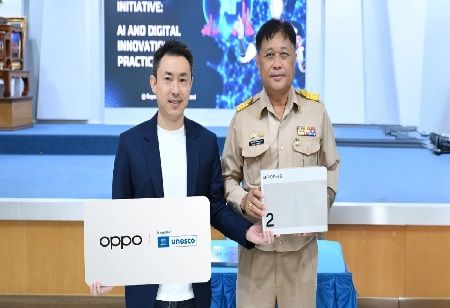
- OPPO completes its pledge to donate 1,000 tablets to schools in Asia and Africa, reinforcing its commitment to digital inclusion and educational equity.
- The initiative, carried out with UNESCO and CODEMAO, supports coding and digital literacy through preloaded Youth Coding Initiative courses for students and teachers.
- Tablet distributions across Thailand and four African countries aim to bridge the digital divide, enabling access to technology-driven learning for students in underserved communities.
OPPO has successfully fulfilled its commitment to donating a total of 1,000 tablets to schools in Asia and Africa, further emphasizing its dedication to promoting educational equity and inclusion through the use of technology. This social campaign was held in partnership with the United Nations Educational, Scientific, and Cultural Organization (UNESCO) and the children’s programming educational franchise CODEMAO, encompassing OPPO’s mission of 'Technology for Mankind, Kindness for the World'. Through the provision of affordable technology, OPPO hopes to narrow the gap created by the lack of access to technology in some developing regions.
One of the important milestones was attained in Thailand, where OPPO handed over 200 tablets to the Lampang Kanlayanee School and Rayongwittayakom School, which was part of the Thailand AI and Digital Innovation Practice Day. This marks the completion of the commitment of distributing the tablets by OPPO. These tools will be utilized by both teachers and students for the implementation of coding education. This aims to help learners develop programming concepts.
The tablets that are donated come preloaded with a list of courses offered by the Youth Coding Initiative. The Youth Coding Initiative is a collaboration involving UNESCO and CODEMAO. The program aims to ensure the beneficial use of technology, especially among the youth. The program provides students with exposure to the basic principles associated with coding, and at the same time, it gives the teachers the tools they need to incorporate technology into the aspects of the students’ daily learning. The program aims at improving the technological capabilities of the students, along with instilling creativity within them.
Also Read: E-Learning Trends Transforming the Landscape of Philippine Education
Outside of Thailand, the donation initiative is spread across four other African nations: Congo Brazzaville, Kenya, Namibia, and Cote d’Ivoire, with each having its own set of challenges in digital learning. In the case of Congo Brazzaville, technology education will be aided through the use of OPPO tablet computers and programming courses, with an emphasis on enhancing educational expertise in these developing fields. Additionally, an aim could be to promote learning amongst one another with coding competitions to inspire the next generation of technology experts.
In countries such as Kenya, Namibia, and Côte d'Ivoire, where access to digital hardware had been limited and consequently influenced learning opportunities, the donation of the tablets will contribute to the creation of new digital classrooms. This particular initiative will thus provide a great opportunity to promote equity in the creation of favorable learning environments where students from disadvantaged backgrounds can equally access vital skills related to digital mastery.
This collaboration with UNESCO reflects the overall commitment of OPPO to youth development and innovation for the greater good. Though UNESCO does not support any particular brand or product, this partnership indicates common interests for inclusive education and transformation in the digital sense. As stated, OPPO has always used technology for the greater good and has emphasized that the company will continue to use empathetic and innovative approaches for the fulfillment of long-standing corporate social responsibility commitments in support of the young generation globally for access to digital education.