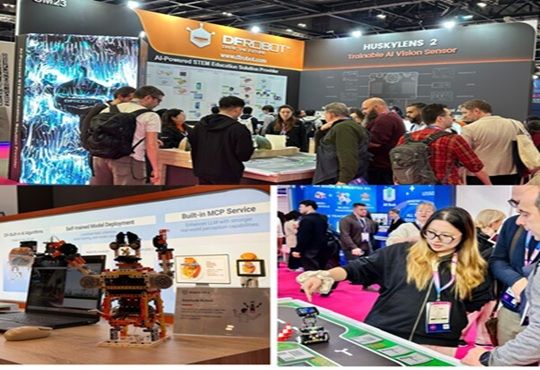
DFRobot, a global provider of open-source hardware and technology solutions, took part in TAMYZ FORUM 2026 in Astana, Kazakhstan, where Vice President Sandy Zhang delivered a keynote address on advancing AI education through practical innovation. The speech highlighted the company’s experience in open-source hardware, artificial intelligence, STEM education, and the development of a worldwide ecosystem for developers and innovators.
TAMYZ FORUM 2026, held on August 17-18, was organised by the Astana City Education Department and the Astana City Methodological Center. Under the theme “Strategic Development of the Education System: Constitutional Values, Artificial Intelligence and Human Capital,” the two-day event brought together educators, experts and technology innovators. It attracted around 3,000 in-person participants and 20,000 online attendees across 15 thematic sessions.
In her keynote, titled 'Advancing AI Education Through Practical Innovation, Sandy Zhang observed that while regions approach AI education differently, several shared priorities are emerging globally. These include curriculum development, student skills, teacher training and the responsible use of AI.
North America is building AI education frameworks and curriculum standards. Europe places strong emphasis on AI literacy, ethics and governance. Many Asian countries are moving from pilot programmes to wider implementation. Despite policy differences, the common focus remains on clear curriculum standards, student competencies, teacher development and responsible AI practices.
Zhang noted a growing gap: students are already using AI tools in daily life, yet many teachers and schools are still exploring effective ways to teach both with and about AI. “What’s important is not simply teaching students how to use AI, but helping them understand how it works, question its outputs, and use technology to create and solve real-world problems,” she said. She stressed that AI education should cultivate a developer mindset understanding technology, thinking critically about data and AI outputs, and turning ideas into practical solutions through hands-on experimentation.
Hands-on learning, she argued, makes AI more understandable. Zhang shared how DFRobot uses open-source hardware to bring AI into the classroom in tangible ways. In one example, students work with the HUSKYLENS 2 AI Vision Sensor to collect and label data, train AI models and deploy them on hardware for real-time visual recognition. Because different groups use different datasets, their models produce varied results. This allows teachers to demonstrate how data shapes AI performance and encourages students to test, analyse and improve their models.
Also Read: AI Literacy Gap: Why Asia's Classrooms Race to Catch Up with Tech
Through this process, students observe, test and refine AI rather than treating it as a black box. The approach also opens natural discussions on data privacy, algorithmic bias and responsible technology use.
Supporting AI education requires more than individual products. DFRobot has built an integrated ecosystem spanning hardware, software, curriculum, platforms and services that covers AI, ICT and STEAM education. The company offers easy-to-use AI hardware, robotics products, sensors and development modules. Its Mind+ programming platform lowers the barrier to AI and hardware development. Curriculum resources, teacher training, hands-on projects and competition support help schools, educators and developers convert technology into real-world applications.
This integrated model serves a wide communityfro m K–12 students and teachers to universities, developers, makers and researchers—providing the tools needed to learn, build and innovate.
Zhang emphasised that the future of AI education and innovation depends on collaboration among governments, international organisations, universities, schools, technology companies and local communities. DFRobot has engaged with international platforms including UNESCO and the Arab League Educational, Cultural and Scientific Organization (ALECSO). It has also partnered with institutions such as Kathmandu University in Nepal and Chiang Mai University in Thailand on curriculum development and teacher training. The company further supports international robotics and innovation competitions that connect education with broader developer and maker communities.
In closing, Zhang underlined the value of an open and collaborative ecosystem that enables more people to take part in technology innovation. “Our shared goal is to help every learner develop creativity, practical problem-solving skills, and basic AI literacy, while learning to use technology responsibly,” she said.
DFRobot will continue its mission of serving innovators and developers worldwide, expanding collaboration across education and technology communities, and making open-source hardware and AI technologies more accessible to those who want to learn, build and create.