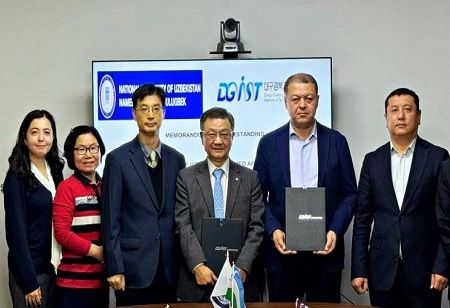
- DGIST signs MOU with National University of Uzbekistan to boost technology management and research collaboration.
- Agreement includes student/researcher exchanges, joint projects, workshops, and full tuition waivers for exchange students.
- Initiative aims to attract Central Asian talent, foster global tech leaders, and strengthen DGIST’s international research network.
DGIST, headed by its president, Kunwoo Lee has signed an MOU with the National University of Uzbekistan to nurture cooperation in technology management and scientific research. The recent MOU, driven by DGIST's Graduate School of Technology and Information Management, was to fortify global research networks while establishing a framework to draw prominent international students, especially from Central Asia, into DGIST's graduate programs.
The move comes after DGIST's Graduate School of Technology and Information Management visited Tashkent, Uzbekistan, between November 2 and 7 to promote academic cooperation and exchanges with leading local universities and learning institutions, such as NUU, Tashkent State Transport University, and Turin Polytechnic University in Tashkent.
During this visit, the delegation conducted pre-interviews and information sessions for students intending to apply for graduate programs at DGIST with advice on how to go about doing so and on studying in Korea. This is also in line with the university's strong desire to seek out quality students who wish to be admitted into the institution.
The plan of the DGIST-NUU collaboration, based on the MOU, is multi-stage: it covers exchanges of students and researchers, joint research projects, academic seminars and workshops, and sharing research and training materials. Most notably, it will provide full tuition fee waivers for exchange students, thereby supporting substantive academic and research exchanges between DGIST and NUU.
This agreement is likely to offer a very good opportunity for substantial collaboration, such as collaborative research and experiential learning programs, while increasing the robust knowledge and expertise exchange in science and technology. DGIST President Kunwoo Lee said, "The institute has been nurturing science and technology talents and expanding the innovation ecosystem through global collaborations. Through the MOU signed with NUU, we will further strengthen education and research exchanges with Central Asia and foster future global leaders who will lead technological innovation".
Also Read: Digital Education Week 2025 Launched in Hong Kong to Champion EdTech
Dean Wujin Chu of the Graduate School of Technology and Information Management said, "This MOU between the two universities is expected to be more than a symbolic academic exchange, rather, it forms a basis for substantial cooperation in technology management education. By constructing an education system for training local human resources, DGIST will offer tailored education and research assistance to selected qualified local talents; they can maintain a close linkage with DGIST while continuing advanced research at DGIST and contributing to the start-up and industrial innovation of their country".
NUU was founded in 1918 as the leading national research university of Uzbekistan, accommodating around 34,000 students and more than 1,200 faculty members with strong research capabilities in physics, mathematics, technology, and science. By signing the MOU, DGIST plans to accelerate student recruitment, especially in the fields of technology management, AI, and engineering, while developing joint research platforms with Central Asian industries, strengthening international collaborative research and education channels, and fostering global leaders in technology management.
The DGIST Graduate School of Technology and Information Management has announced an application for admission in 2026 with a curriculum in the latest, cross-disciplinary programs in AI-based technology management, innovation strategy, technology commercialization, and data-driven decision-making, reinforcing academic knowledge as well as practical industrial experience.