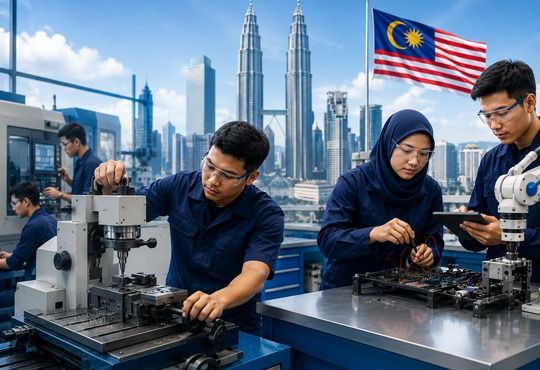
Malaysia has introduced an ambitious five-year roadmap to elevate its Technical and Vocational Education and Training (TVET) system, aiming to position the country as a regional leader in skills-based education and workforce development. The new 2026–2030 TVET Internationalisation Roadmap, unveiled by the Ministry of Human Resources, is designed to align Malaysian vocational qualifications with international standards while preparing graduates for the demands of a rapidly evolving global economy.
A key component of the strategy is the SkillsMalaysia Global initiative, which seeks to increase the international recognition of Malaysian vocational certifications. Through this programme, the government plans to strengthen partnerships with overseas institutions, improve quality assurance frameworks, and promote the mobility of skilled workers across international labour markets.
Government officials said the roadmap reflects Malaysia's commitment to developing a highly skilled workforce capable of supporting industries undergoing digital transformation. As technologies such as artificial intelligence (AI), automation, robotics, advanced manufacturing, and renewable energy continue to reshape global economies, demand for workers with practical, industry-relevant skills is increasing rapidly.
The Department of Skills Development will play a central role in implementing the roadmap. Planned initiatives include updating occupational standards, modernising training curricula, expanding digital learning opportunities, and encouraging stronger collaboration between education providers and industry partners. These measures are intended to ensure that graduates possess the technical competencies and practical experience employers increasingly require.
Human Resources Minister Datuk Seri R. Ramanan described the roadmap as a significant milestone in Malaysia's long-term workforce strategy. According to the ministry, internationally recognised qualifications will not only improve graduate employability but also strengthen Malaysia's reputation as a destination for high-quality vocational education.
Industry leaders have welcomed the announcement, noting that many employers continue to face shortages of skilled technicians and technology professionals. By bringing training programmes closer to real-world industry requirements, the roadmap is expected to narrow the gap between education outcomes and labour market needs.
Another important objective of the strategy is to promote lifelong learning. Workers already in employment will be encouraged to upgrade their skills through flexible training programmes, online courses, and professional certification pathways. This continuous learning approach is becoming increasingly important as technological advancements create new occupations while transforming existing roles.
Digital transformation also features prominently in the government's plans. Training institutions are expected to adopt smart classrooms, simulation technologies, virtual laboratories, AI-assisted learning tools, and digital assessment systems. These innovations will help students gain hands-on experience with modern technologies before entering the workforce.
The roadmap further encourages closer cooperation between Malaysian institutions and international organisations. Cross-border collaborations are expected to facilitate knowledge sharing, curriculum development, faculty exchanges, and joint certification programmes, helping Malaysian graduates compete more effectively in regional and global job markets.
Education analysts believe Malaysia's initiative reflects a broader trend across Asia, where governments are investing heavily in vocational education as a driver of economic growth. Countries throughout the region are increasingly recognising that future competitiveness depends not only on university education but also on highly skilled technical professionals capable of supporting advanced industries.
The roadmap also supports Malaysia's broader economic ambitions, including strengthening high-value manufacturing, digital services, green technology, healthcare, logistics, and infrastructure development. By producing graduates with internationally recognised qualifications, the country hopes to attract greater foreign investment while creating higher-quality employment opportunities for its citizens.
As global industries continue to evolve, vocational education is becoming an increasingly important pillar of national development strategies. Malaysia's latest reforms demonstrate a long-term commitment to equipping learners with practical, future-ready skills that meet international standards and industry expectations.
With the successful implementation of the 2026–2030 roadmap, Malaysia aims to establish itself as one of Asia's leading centres for technical education, helping students, employers, and the wider economy benefit from a workforce prepared for the challenges and opportunities of the digital age.