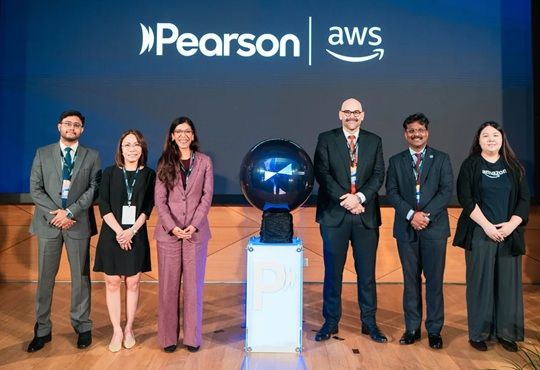
Pearson and Amazon Web Services have released a new Malaysia-focused report titled AI Readiness: Building the Bridge from Higher Education to Work. The findings reveal a clear confidence gap: students and educators largely believe the country is preparing well for an AI-driven future, while employers remain less convinced that graduates currently possess the right skills.
The report forms part of a broader international study involving more than 2,700 students, educators and employers across Malaysia, the United States, the United Kingdom, Brazil, Saudi Arabia and Vietnam. It is supported by interviews with higher education leaders. The Malaysian sample comprises 402 participants: 300 learners, 51 educators and 51 employers.
The timing is significant. Malaysia is pursuing its ambition to become an AI Nation by 2030 under the National AI Action Plan 2026-2030. Officials estimate that AI could contribute up to USD 115 billion to the country’s GDP by that year. Against this backdrop, the study examines how well higher education is equipping the workforce for AI adoption.
Nearly half of Malaysian educators (49 percent) believe their institutions are keeping pace with most or all AI developments. This figure stands well above the 32 percent cross-market average. Learners are similarly optimistic, with 77 percent stating they feel ready for the workforce. Employers, however, paint a different picture. Sixty-nine percent identify finding graduates with the right skills as a primary AI-related challenge, and 45 percent specifically point to limited practical experience or application skills among new graduates.
The groups also diverge on the capabilities they value most. Educators prioritise functional AI tool use (47 percent) and creativity and innovation (45 percent). Employers place greater emphasis on communication and collaboration (51 percent), the ability to combine human judgment with AI (51 percent), and adaptability (41 percent).
Despite these differences, there is broad agreement on the continued value of university education. About 80 percent of higher education leaders and 76 percent of employers believe AI makes university education more important, not less. Among learners, 70 percent say their university education is preparing them well. At the same time, 49 percent want more practical experience and 37 percent seek additional opportunities for AI-based problem-solving. A hybrid model that gives equal weight to university study and practical work experience is favoured by 52 percent of learners and 53 percent of employers.
Perceptions of the speed of change also vary. Seventy-one percent of learners and 70 percent of educators describe AI-driven change as extremely or very fast, compared with 61 percent of employers.
The study classifies Malaysia as a “Fragmented Adaptive” market. In this category, the core challenge is not generating interest in AI readiness but converting existing momentum into consistent, governed and professionally relevant outcomes. To address this, the report introduces the AI Readiness Friction Framework. The framework identifies six compounding frictions that slow the transition from education to work: pace, connection, capability, governance, experience and skills. Each friction is paired with concrete recommendations aimed at educators, employers and policymakers.
Craig McFarlane, Pearson’s Vice President for APAC Enterprise Learning and Skills, noted that the foundations for progress are already in place. He emphasised the need to support faculty in keeping pace with developments, embed more practical learning, deepen employer co-design of programmes, and establish clear governance for trusted AI use.
Valerie Singer of AWS added that employers want graduates who can apply AI to real problems. Stronger and more sustained dialogue between employers and educators, she said, is essential to delivering those graduates.
Also Read: Why 60,000 Microsoft Jobs Are Up for Exit?
The report was launched at an event that included a leadership panel discussion and demonstrations of AI-enabled learning, assessment, credentialing and employability pathways. The findings underline both the opportunity and the work still required if Malaysia is to close the gap between educational confidence and workplace readiness as it advances toward its 2030 AI Nation goals.
The full report is available through Pearson and AWS channels for stakeholders seeking detailed data and the complete set of recommendations from the AI Readiness Friction Framework.