Synopsis
South Korea has launched the K-Moonshot Project to accelerate AI-driven scientific innovation and build future-ready skills across sectors like healthcare, semiconductors, robotics, and space technology.
South Korea has launched an ambitious national initiative called the K-Moonshot Project to speed up artificial intelligence-led breakthroughs across science, education, and advanced technology sectors.
The project, introduced by the Ministry of Science and ICT, aims to combine AI with scientific research to improve research productivity, strengthen future workforce skills, and increase the country’s global competitiveness.
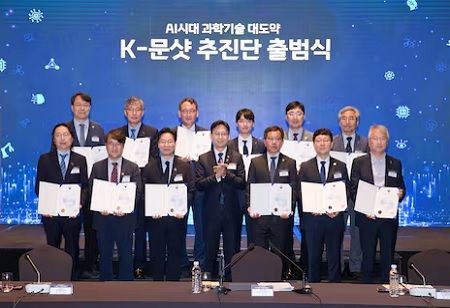
Government officials officially launched the program during an event held in Seoul, where 12 mission leaders were appointed to guide major national research projects. The government also activated the K-Moonshot Steering Group, an inter-ministerial body that will oversee the initiative.
The program focuses heavily on preparing South Korea’s education and research ecosystem for the next generation of AI-driven industries. Officials said the project aims to double research productivity by 2030 and solve major national challenges by 2035.
The missions cover several advanced technology fields, including AI-powered drug discovery, brain-computer interfaces, fusion energy, humanoid robotics, semiconductors, quantum technology, physical AI systems, and space infrastructure.
The initiative is expected to create new opportunities for students, researchers, engineers, and technology professionals as universities and research institutions work closely with industry and government agencies.
Among the key goals are accelerating drug development, commercializing brain implants, developing a Korean fusion pilot reactor, building space data center technologies, and strengthening domestic capabilities in physical AI and advanced computing. The government appointed experts from universities, research institutes, and technology companies to lead each mission.
Also Read: China's Young Engineers Are Powering the Global EV Revolution
The selected program directors include professors and researchers from institutions such as Hanyang University, Korea University, KAIST, and Seoul National University. Industry leaders are also involved in the initiative. Yeo Jun-gu, CEO of Daedong Robotics, will lead the humanoid robotics mission. Officials said the project is designed not only to support scientific breakthroughs but also to strengthen collaboration between academia, industry, and government agencies.
The K-Moonshot Steering Group will be led by the Deputy Prime Minister and the Minister of Science and ICT. The body will monitor progress, coordinate policies, and support research funding across missions. The government also plans to reduce administrative barriers between ministries so research projects can move faster from the laboratory stage to real-world industrial applications.
Several ministries will participate in different missions. The Ministry of Health and Welfare will support projects related to healthcare and brain-computer interfaces, while the Ministry of Trade, Industry and Energy will contribute to AI, robotics, and semiconductor missions.
Education and skill development are expected to play a major role in the project’s success. Experts believe the initiative could help South Korea prepare students and professionals for future jobs in AI research, robotics engineering, semiconductor manufacturing, healthcare technology, and quantum computing. As global competition in advanced technologies intensifies, South Korea is positioning itself to build a highly skilled workforce capable of leading the next generation of AI-powered innovation.