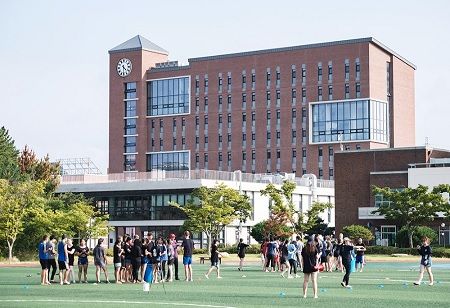
Handong Global University has taken a major step toward reshaping higher education through a strong focus on AI-driven education transformation, hosting a large-scale academic showcase dedicated to the future of learning, skill development, and institutional change. The event, held at the Kim Young-gil Grace School Chapel on campus, brought together more than 100 faculty members, administrators, and education professionals from across South Korea, reflecting the rising importance of artificial intelligence in higher education and its impact on teaching and learning systems.
Organized by the university’s AI Innovation Center under its broader Glocal University Initiative, the program examined how AI is reshaping classrooms, curriculum design, and student engagement. Key discussions focused on AI-supported curriculum development, competency-based learning models, personalized student support systems, and strengthened AI security measures for academic environments. The sessions highlighted a broader shift in universities toward more flexible, skills-oriented education systems driven by technology rather than traditional lecture-based instruction.
International experts contributed global perspectives on education reform. Education specialist Dale Johnson discussed how AI is transforming learning environments and restructuring education systems worldwide. He also highlighted the ongoing collaboration between Handong Global University and Arizona State University, particularly their joint development of the High Touch High Tech learning model, which blends human interaction with digital tools to create more engaging and personalized classroom experiences.
Another keynote speaker, Philippa Kim, focused on competency-based education approaches, emphasizing four essential future skills: critical thinking, creative thinking, communication, and collaboration. These abilities are increasingly viewed as critical for students entering a workforce shaped by rapid technological change and AI integration.
Also Read: Chitkara University Joins a Global Network of Innovative Universities
Through its international partnerships, Handong Global University and Arizona State University have jointly developed more than 60 courses based on this new learning framework. The university has also introduced an AI-based program developed through the Minerva partnership across six general education subjects. Rather than focusing on technical tool usage, the program emphasizes understanding, evaluating, and critically analyzing AI systems. After its introduction, the university reported a 20% increase in student satisfaction, signaling strong engagement with AI-integrated education models.
The showcase also featured several AI-powered academic tools designed to enhance learning support. These include an AI-based academic advising system that uses enrollment and graduation data to guide students more effectively, and an AI tutoring platform called LEIA, which applies a Socratic learning method to encourage deeper questioning, discussion, and critical thinking. Together, these tools represent a shift toward more personalized and interactive academic support systems.
University researchers also presented findings from an AI security review, identifying risks associated with deploying AI in academic environments, particularly within Korean-language systems. The findings emphasized the need for stronger safeguards, ethical standards, and institution-specific protections as AI becomes more deeply embedded in education.
Officials at the university stressed that the future of education is not only about replacing traditional methods with technology but about redefining the role of educators in an AI-enabled environment. They noted that teachers will increasingly act as facilitators and mentors rather than content-only instructors.
As part of its long-term strategy, Handong Global University has launched an AI Open Innovation Center in partnership with the city of Pohang and plans to extend its education model to local schools and regional industries. This reflects a broader trend across Asia toward building future-ready education systems designed to prepare students for careers shaped by artificial intelligence and rapidly evolving digital economies.