
-
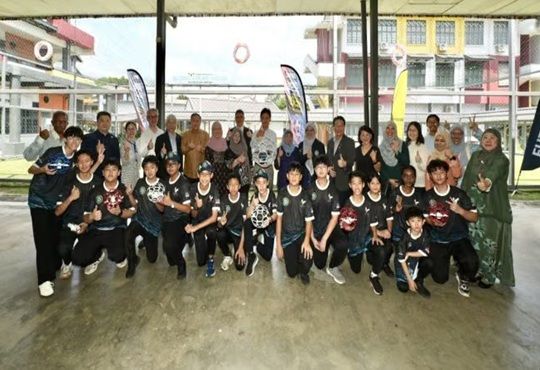
Sri Bestari Private School has officially launched the Global Drone Arena, a purpose-built facility dedicated to drone soccer and obstacle-based flight activities. The project, developed in collaboration with Futurise through its National Academy for Drone Sports Excellence (AKSADRON) programme, aims to give students structured training and hands-on experience in drone technology while building technical, problem-solving and future-ready skills.
The arena marks a significant step in integrating competitive drone sports into mainstream school education in Malaysia. Located in Cyberjaya, the country’s premier technology and innovation hub, the facility provides a controlled environment where students can practise precision flying, teamwork and strategic thinking through drone soccer matches and challenging obstacle courses. Organisers say the programme is designed not only to introduce young people to emerging technology but also to prepare them for careers in aviation, robotics, engineering and digital innovation.
Drone soccer, a fast-growing sport that combines aerial manoeuvres with competitive gameplay, requires pilots to control small drones through goals while avoiding obstacles and opposing teams. Obstacle-based flight activities further develop fine motor skills, spatial awareness and quick decision-making. By embedding these activities into the school’s curriculum and co-curricular offerings, Sri Bestari and Futurise hope to make advanced technology accessible and engaging for students of varying ages and skill levels.
Futurise, a key player in Malaysia’s technology ecosystem, has positioned the AKSADRON programme as a national initiative to develop excellence in drone sports. Through the partnership, students gain access to specialised coaching, standardised training modules and opportunities to compete at higher levels. Officials involved in the launch emphasised that the arena will serve as both a training ground and a talent pipeline, identifying and nurturing young individuals who show aptitude for technology-driven fields.
Education experts note that drone-based learning offers unique advantages over traditional classroom methods. Operating a drone demands real-time problem-solving, understanding of aerodynamics, basic electronics and coding principles in some advanced modules. Students must also collaborate in teams, communicate effectively under pressure and adapt strategies during matches. These soft and technical skills align closely with the competencies employers increasingly seek in the digital economy.
The timing of the launch reflects broader national priorities. Malaysia has been actively promoting STEM education and Industry 4.0 readiness. Cyberjaya itself was developed as a smart city and technology corridor, making it a natural location for an initiative that blends education with cutting-edge technology. School leaders at Sri Bestari described the Global Drone Arena as a logical extension of their commitment to innovative learning environments that prepare students for a rapidly changing world.
During the launch event, representatives from both organisations highlighted the facility’s dual purpose: recreational and competitive sport on one hand, and structured skill development on the other. Students will be able to progress from introductory sessions focused on basic flight control to more advanced training that includes tactical drone soccer and complex obstacle navigation. Safety protocols, supervised sessions and age-appropriate equipment form core elements of the programme, ensuring responsible and inclusive participation.
Beyond the immediate school community, the arena is expected to create wider impact. Futurise’s involvement through AKSADRON opens pathways for inter-school competitions, regional events and potential national representation. Such platforms can elevate drone sports in Malaysia and inspire similar facilities in other educational institutions. Industry observers suggest that early exposure to drone technology may also encourage more students to pursue related tertiary studies and careers in unmanned aerial systems, logistics, mapping, agriculture technology and defence applications.
Parents and educators attending the launch expressed enthusiasm for the hands-on approach. Many noted that traditional academic subjects sometimes struggle to capture the imagination of digitally native students. Competitive drone activities, by contrast, turn learning into an engaging challenge that rewards persistence, creativity and continuous improvement. The programme also offers opportunities for students who may not excel in conventional sports to discover a new arena in which they can succeed and build confidence.
Also Read: UNESCO Promotes STEAM Education Among Vietnamese Girls
Looking ahead, organisers plan to expand the range of activities and deepen the curriculum links. Future modules could incorporate elements of data analysis from flight logs, basic programming for autonomous flight sequences, and design challenges for custom drone modifications. Partnerships with local technology firms and universities are also under consideration to provide mentorship and real-world project experience.
The Global Drone Arena arrives at a moment when governments and educators worldwide are searching for effective ways to equip young people with the skills needed for an automated and connected future. By combining sport, technology and structured learning, Sri Bestari Private School and Futurise have created a model that other institutions may look to replicate. The initiative demonstrates that purpose-built facilities, when paired with clear educational objectives and strong industry collaboration, can turn abstract concepts of future readiness into tangible, daily experiences for students.
As the first cohorts begin regular training sessions, the success of the arena will be measured not only by competition results but by the technical confidence, problem-solving ability and collaborative mindset students develop. In a world increasingly shaped by drones and autonomous systems, early and practical exposure of this kind may prove decisive in shaping the next generation of innovators and technology leaders in Malaysia and beyond.
The launch of the Global Drone Arena stands as a concrete example of how schools and technology partners can work together to move beyond conventional teaching methods and create learning environments that are both relevant and inspiring. With its focus on structured training, competitive engagement and future-oriented skills, the facility is positioned to become a landmark in Malaysia’s educational and technological landscape.
🍪 Do you like Cookies?
We use cookies to ensure you get the best experience on our website. Read more...