
-
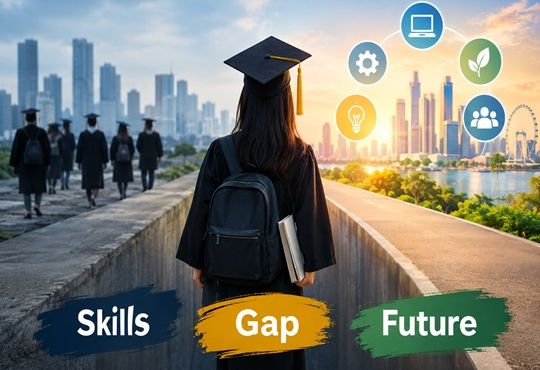
Across Southeast Asia, economies continue to expand, digital transformation accelerates, and millions of young people complete tertiary education each year. Yet a growing number of graduates leave university only to find themselves unemployed, underemployed, or locked into roles that do not match their qualifications. This is not a simple shortage of jobs. It is a deepening skills crisis that threatens productivity, social mobility, and the region’s long-term competitiveness.
The problem is visible in official statistics and employer surveys alike. According to the International Labour Organization, more than 16 percent of youth in ASEAN were not in education, employment, or training (NEET) in 2024. In several countries the figure is significantly higher. At the same time, employers repeatedly report that they cannot find graduates with the right combination of technical, digital, and soft skills. The mismatch is costly.
QS analysis estimates that better alignment between higher education and labour-market needs could generate an additional US$900 billion in economic value across ASEAN by 2035. Digital transformation alone is projected to create 65 million new jobs in the region by 2030, yet many graduates still lack the advanced digital and green competencies required to fill them.
Sunmee Choi, Ph.D., Vice Provost for External Engagement, VinUniversity, Vietnam, says, "As higher education continues to evolve alongside rapid advances in artificial intelligence and digital technologies, the institutions most likely to succeed will be those that deliberately combine academic excellence with meaningful collaboration, authentic experiential learning, and holistic student development".
The Regional Picture: Low Headline Unemployment, High Underemployment
Headline unemployment rates in several ASEAN economies remain relatively low by global standards. Thailand and Vietnam have recorded youth unemployment figures around 4-5 percent in recent periods, while overall rates in Malaysia and Singapore stay in the low single digits. These numbers, however, mask a more troubling reality: large numbers of graduates are employed below their skill level.
Case Study 1: Malaysia - The Underemployment Paradox
In Malaysia, the graduate unemployment rate fell to 3.2 percent in 2024 near a decade low with roughly 165,900 unemployed graduates out of a graduate labour force of more than 5 million. Yet skill-related underemployment stood at 1.60 million people, or 32.2 percent of employed degree and diploma holders. By the third quarter of 2025 that figure had risen further to approximately 1.96 million, or 35.5 percent. Department of Statistics Malaysia data place the country better than Indonesia (42.2 percent) and the Philippines (56.7 percent) on this measure, but still behind advanced economies such as the United States, Australia, and the United Kingdom.
The human face of this paradox appeared in June 2026 when videos of nearly 1,000 people queuing up to 2 kilometres for only 500 vacancies at an Infineon Technologies open interview in Melaka went viral. Many of those in line were degree holders. Human Resources Minister R. Ramanan acknowledged the challenge in Parliament, noting that the government is accelerating labour-market reforms precisely because graduates are working outside their fields of qualification. The data show that the problem is not a lack of jobs overall, but a shortage of roles that match the skills graduates have acquired.
Case Study 2: Indonesia - One Million Unemployed Graduates Amid a Digital Talent Shortage
Indonesia presents an even sharper contrast. The country has more than one million unemployed university graduates even as employers face a severe shortage of digital talent. Projections indicate Indonesia will need around 12 million digital specialists by 2030, compared with a current base of only about three million. Youth unemployment has hovered near 16 percent, and the NEET rate has reached roughly 21 percent in some estimates among the highest in ASEAN. Only about 53 percent of graduates work in roles aligned with their field of study.
A July 2026 Pearson and Amazon Web Services study underlined the urgency: more than half of employers worldwide cannot find graduates with the AI skills they need. In Indonesia the timing is especially pointed. Graduate unemployment rose to 6.23 percent in early 2025 even as the national rate fell. Under the Merdeka Belajar framework, university funding is now partly tied to graduate employment outcomes (IKU 1 metric), creating pressure on institutions to close the gap. Horizontal mismatch remains widespread, and many young people lack the teamwork, communication, and presentation skills demanded by high-growth sectors such as technology, logistics, and renewable energy.
Case Study 3: Vietnam - Youth Unemployment Peaks While Firms Struggle to Hire
Vietnam has seen youth unemployment climb to a recorded peak of 9.03 percent in the third quarter of 2025, while the overall working-age unemployment rate remained near 2.2 percent. By the end of 2025, 1.4 million young people aged 15–24 were classified as NEET (10.2 percent of the cohort). Young women were disproportionately affected, with a NEET rate of 12.1 percent compared with 8.3 percent for young men.
ManpowerGroup’s 2025 Talent Shortage Report found that nearly 80 percent of companies across Asia-Pacific report difficulty finding workers with suitable skills almost double the level recorded a decade earlier. In Vietnam the mismatch is especially visible as Generation Z enters the workforce in larger numbers. Employers note that while many young people are strong in digital tools and foreign languages, they often lack practical workplace skills such as communication, problem-solving, and handling pressure. The result is a paradoxical labour market: firms cannot fill vacancies in IT, engineering, healthcare, finance, and sustainability, while large numbers of educated youth remain outside stable employment.
Dr Stephen Hodges, CEO, Efekta Education Group, echoes, Language is a practical skill. No one learns to swim by reading a book about swimming, they must enter the water, attempt the strokes, and receive guidance on what they are doing wrong.
Case Study 4: Singapore - Falling Full-Time Employment Rates for Fresh Graduates
Even Singapore, often regarded as a regional benchmark, shows pressure on new graduates. While overall unemployment remains very low at around 1.9 percent, full-time employment rates among recent public-university graduates have declined. From 87.5 percent in 2022, the rate fell to 74.4 percent for the 2025 cohort a drop of more than 13 percentage points in three years. Of approximately 18,000 public-university graduates in one recent cycle, only about half had secured employment by mid-year, with a significant share continuing studies or temporarily leaving the labour force.
Singapore’s Adult Learning Institute has noted that the speed of change in skill requirements is roughly 2.4 times faster than in the United States. As AI absorbs routine entry-level tasks, organisations are rethinking how new employees gain professional judgment. The result is longer transition periods for fresh graduates even in a strong overall labour market.
Root Causes of the Mismatch
Several interconnected factors drive the crisis.
First, curricula in many universities lag behind labour-market realities. Degree programmes designed years or decades earlier continue to produce graduates in fields with limited demand while leaving shortages in technical, digital, analytical, and green skills. Employers consistently highlight gaps in critical thinking, problem-solving, adaptability, and communication.
Second, the rise of artificial intelligence and automation is reshaping entry-level work. ILO analysis indicates that nearly 80 million workers across ASEAN are employed in occupations with some degree of potential exposure to generative AI. While large-scale job losses have not yet materialised, employment growth in highly exposed occupations has been weaker among young workers than among adults.
Third, demand-side constraints play a significant role. In several economies the creation of high-skilled, high-productivity jobs has not kept pace with the rapid expansion of tertiary education. Graduates therefore accept lower-skilled roles simply to remain employed.
Fourth, foundational and digital skills remain uneven across the region. Singapore and Malaysia report relatively higher levels of advanced digital competencies, while other countries continue to face gaps. World Economic Forum data show that 43 percent of employers in South-Eastern Asia expect today’s core skills to be disrupted by 2030 higher than the global average.
Economic and Social Stakes
The consequences extend beyond individual frustration. Skill-related underemployment carries a clear wage penalty. Tertiary-educated workers in lower-skill roles earn substantially less than those in matched positions. Over time this reduces the returns to education and limits the contribution of human capital to productivity growth.
At the macroeconomic level, the opportunity cost is large. Closing the alignment gap could unlock US$900 billion by 2035. Failure to prepare graduates for digital and green transitions risks leaving ASEAN economies unable to capture the full benefits of the projected 65 million new digital jobs. Youth who remain NEET or trapped in informal, low-productivity work represent a lost demographic dividend.
Also Read: ASEAN Unveils 2026-2030 Plan to Advance AI and STEM Education
Pathways Forward
The crisis is not inevitable. Several practical responses are already emerging and showing results.
Microcredentials and short, industry-aligned programmes offer one promising route. Research from the Economic Research Institute for ASEAN and East Asia highlights microcredentials as a way to deliver job-relevant skills quickly, assessed against industry standards. Employers are increasingly shifting toward skills-based hiring rather than relying solely on degree pedigree.
Closer partnerships between universities and industry are essential. In Malaysia, programmes linked to the National Occupational Skills Standards and industry academies have achieved higher rates of field-aligned employment. Work-integrated learning and apprenticeships reduce transition friction.
Curriculum reform must accelerate. Expanding STEM and AI-related programmes while embedding critical thinking, problem-solving, sustainability, and socio-emotional skills across disciplines is repeatedly recommended. Lifelong learning systems will become equally important as AI continues to reshape occupations.
Governments can strengthen labour-market information systems so that students, universities, and employers share clearer signals about current and emerging skill needs. Active labour-market policies that support job matching, career guidance, and targeted upskilling for young people and women can improve outcomes. Regional cooperation on skills standards and mutual recognition of qualifications would also help talent move more freely across ASEAN.
Demand-side measures remain critical. Policies that encourage high-value investment, technology transfer, and the growth of knowledge-intensive sectors are necessary to create the skilled jobs that graduates are trained for.
Conclusion!
ASEAN’s skills crisis is not primarily a story of too many graduates or too few jobs. It is a story of misalignment between what universities teach, what employers need, and the pace at which high-productivity roles are created. The concrete experiences of Malaysia’s 1.96 million underemployed graduates, Indonesia’s one million unemployed university graduates against a 12-million digital talent shortfall, Vietnam’s rising youth unemployment amid employer shortages, and Singapore’s declining full-time placement rates for fresh graduates all point to the same structural challenge.
The opportunity remains substantial. With focused investment in relevant skills, stronger education-industry linkages, adaptive curricula, and policies that expand high-value employment, ASEAN can convert its large young population into a genuine competitive advantage. The alternative is a generation of graduates whose potential is underused, economies that fall short of their productivity frontier, and a region that risks missing the full benefits of the digital and green transitions already under way.
The choices made in the next few years by universities, employers, and governments will determine whether ASEAN’s graduates become the drivers of the next phase of growth or remain caught in a cycle of underemployment and delayed opportunity. The evidence from across the region is clear. The time to close the gap is now.
🍪 Do you like Cookies?
We use cookies to ensure you get the best experience on our website. Read more...