
-
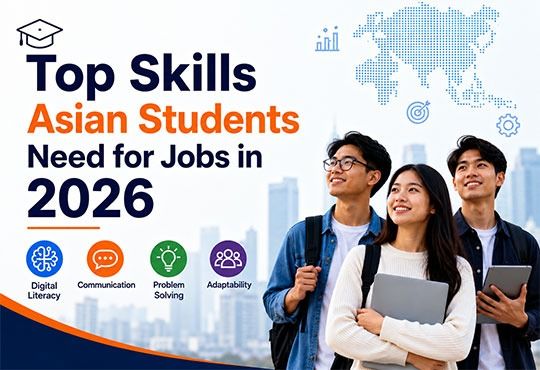
For millions of students across Asia, earning a degree remains an important step toward building a successful career. But the workplace they are preparing to enter is changing rapidly.
Artificial intelligence, automation, digital platforms, global businesses and changing employer expectations are reshaping the skills required across industries. A strong academic record can open the door to an interview, but practical skills increasingly determine what graduates can contribute once they enter the workplace.
For students in India, Singapore, Japan, South Korea, Malaysia, Indonesia, the Philippines, Vietnam and other Asian economies, this shift presents both a challenge and an opportunity.The question is no longer simply what students study. It is also about the capabilities they develop alongside their education.
1. AI and Digital Literacy
Artificial intelligence is becoming part of everyday work across technology, finance, marketing, healthcare, education, manufacturing, consulting and many other sectors.
Students do not necessarily need to become AI engineers. However, they should understand the fundamentals of AI and learn to use digital tools responsibly and effectively. This includes evaluating AI-generated information, protecting data, working with digital platforms and learning new technologies.
The importance of developing these capabilities is becoming clearer as AI moves into more areas of education and employment.
“What’s important is not simply teaching students how to use AI, but helping them understand how it works, question its outputs, and use technology to create and solve real-world problems.” - Sandy Zhang, Vice President, DFRobot.
For Asian students, this is an important distinction. Learning to operate an AI tool is only one part of becoming digitally capable. Students also need the judgement to question information, understand data and use technology to address practical challenges.
Digital literacy is therefore becoming more than an additional skill. It is becoming a foundation for employability in a technology-driven workplace.
2. Analytical and Critical Thinking
Students today have access to more information than ever before. The challenge is knowing which information is accurate, useful and relevant.
Analytical thinking helps students examine information, identify patterns, understand problems and make informed decisions. It is valuable across almost every sector.
A business graduate may use analytical thinking to assess market trends. An engineering student may apply it to solve technical problems. A healthcare professional may need it to interpret information and support decisions.
Critical thinking is also becoming increasingly important as students use AI tools for research and learning. Technology can provide an answer quickly, but students still need to determine whether the answer is reliable and appropriate.Students can strengthen these abilities through case studies, research projects, debates, practical assignments and real-world problem-solving exercises.
3. Communication Skills
Strong communication remains one of the most valuable abilities a graduate can develop.
A student may have excellent technical knowledge, but that knowledge becomes more valuable when they can explain an idea clearly, prepare a professional presentation, write effectively or communicate with a client.
Asian students are increasingly entering workplaces where teams operate across countries and cultures. A graduate in India may work with colleagues in Singapore or Japan. A professional in Vietnam may work with an international manufacturing team. A graduate in the Philippines may support customers across multiple global markets.Communication therefore needs to go beyond classroom presentations.
Students should develop:
- Professional writing
- Public speaking
- Presentation skills
- Active listening
- Business communication
- Cross-cultural communication
Clear communication can help graduates turn knowledge into workplace impact.
4. Adaptability and Continuous Learning
A qualification can provide a foundation, but learning cannot stop at graduation.Industries are evolving rapidly, and new technologies can change job responsibilities within a short period. Students therefore need the confidence to learn new tools, update their knowledge and adjust to unfamiliar situations.
Adaptability is particularly important for young professionals because their first job may not resemble the role they eventually build their career around.
Students can develop this mindset by exploring subjects beyond their main course, taking online courses, participating in internships and following developments in their chosen industry.
Instead of focusing only on “What job can my degree get me?”, students can also ask:
“What can I learn next?”
That mindset can help graduates remain relevant as industries evolve.
5. Creative Thinking
Artificial intelligence can generate information, analyse data and support routine tasks, but organizations still need people who can develop fresh ideas and approach problems from different perspectives.Creative thinking is therefore becoming valuable across industries.
An engineer may need a new approach to product design. A marketer may need an original campaign. An entrepreneur may need a new business model. A teacher may need an engaging learning experience.
Creativity is not limited to students pursuing arts or design. It can strengthen performance in almost every profession.
Students can develop creative thinking by working on projects that allow them to experiment, test ideas and develop solutions rather than simply reproduce information from textbooks.
6. Collaboration and Teamwork
Modern workplaces depend heavily on collaboration.Students may eventually work with people from different departments, countries, cultures and professional backgrounds. Being able to contribute effectively within a team can therefore make a significant difference.
Good teamwork involves listening, sharing responsibility, accepting feedback, managing disagreements and working toward a shared objective.
For Asia's increasingly interconnected workforce, collaboration also means understanding cultural differences and respecting different approaches to work.
Students can develop these abilities through group projects, student organizations, competitions, internships and community activities.
7. Emotional Intelligence
Technology is transforming many workplace processes, but human relationships remain central to professional success.
Emotional intelligence helps individuals understand their own reactions, recognise the perspectives of others and respond appropriately in different situations.
It can support:
- Better teamwork
- Leadership
- Conflict management
- Client relationships
- Workplace communication
- Decision-making
As automation handles more routine activities, the ability to understand people, build trust and communicate with empathy can become even more valuable.For students, emotional intelligence can also make the transition from campus life to professional life smoother.
8. Data Literacy
Data has become part of decision-making across almost every major industry.Students do not all need to become data scientists. But they should be comfortable reading information, understanding basic statistics, interpreting charts and identifying meaningful patterns.
Data literacy can benefit students studying:
- Business
- Finance
- Marketing
- Healthcare
- Engineering
- Education
- Social sciences
A graduate who can combine industry knowledge with basic data understanding can bring greater value to an organization.
Even students outside technology-related fields can benefit from understanding the numbers behind business and professional decisions.
9. Problem-Solving
Employers need graduates who can apply knowledge to real situations.
Problem-solving involves understanding an issue, collecting relevant information, considering possible solutions, assessing risks and selecting a practical response.
This is also where practical education becomes important. Students who work on real projects can learn to move beyond theoretical answers and deal with the uncertainty that often comes with real-world problems.
Universities can strengthen this skill through internships, industry projects, simulations, entrepreneurship programmes and practical assignments.
For students, these experiences can also provide evidence of what they can actually do when they enter the job market.
10. Sustainability and Green Skills
Asia's economic growth is increasingly connected with sustainability.
Renewable energy, electric mobility, sustainable manufacturing, green buildings, responsible supply chains and climate-focused technologies are creating new areas of employment.
Green skills are not limited to environmental science students.
Engineers, architects, finance professionals, supply-chain specialists, consultants, technology professionals and business managers can all contribute to sustainability initiatives.
Students who understand sustainability can therefore bring an additional perspective to their future careers, particularly as organizations increasingly consider environmental and social responsibilities alongside business performance.
Also Read : How Asia Funds Future Careers Through 10 Government Scholarships
A Degree Still Matters, But Skills Complete the Picture
The growing importance of skills does not mean that university education has lost its value.
A degree can provide subject knowledge, structured learning, professional networks and a foundation for long-term career development. The bigger change is that students increasingly need to connect that academic knowledge with practical capabilities.
A student studying business, engineering, medicine, design or technology can strengthen their career prospects by developing skills outside the boundaries of their academic syllabus.The combination is important.
Education provides knowledge. Skills demonstrate application. Experience provides evidence.
Together, they can create a stronger profile for a competitive job market.
Skills That Can Travel Across Asian Markets
One advantage for Asian students is the region's growing economic connectivity.
Companies increasingly operate across borders, creating opportunities for graduates who can work in multicultural environments and understand different markets.
A student in India may eventually work for a Singapore-based company. A graduate from Malaysia may join a regional technology firm. A student in Vietnam may enter an international manufacturing organization. A graduate from the Philippines may work with customers across multiple countries.
This makes transferable skills especially valuable.
AI literacy, communication, analytical thinking, adaptability, teamwork and problem-solving can support careers across different industries and countries.
Students should therefore think beyond their first job and build capabilities that can remain useful as their careers move across organizations, sectors and markets.
What Students Can Start Doing Today
- Building these skills does not always require another degree.
- Students can begin through practical experiences.
- Build a project: Create something connected to your field of study and use it to demonstrate your abilities.
- Take an internship: Gain exposure to real workplace expectations and learn from professionals.
- Learn digital tools: Become comfortable with AI, data and productivity platforms relevant to your field.
- Improve communication: Practise presentations, professional writing and public speaking.
- Create a portfolio: Show employers what you can actually do instead of relying only on a list of qualifications.
- Work in teams: Participate in competitions, clubs, research projects or community initiatives.
- Keep learning: Follow developments in your industry and regularly update your skills.
- These steps can gradually turn academic knowledge into career readiness.
Preparing for the Future of Work in Asia
The Asian job market will continue to evolve as technology, business models and industries change.
The students best prepared for this environment will not necessarily be those who know every new technology. They will be those who can learn, adapt, communicate, solve problems and use technology effectively.
For universities, this creates an opportunity to connect classroom learning more closely with industry requirements. For employers, it creates a reason to strengthen internships, graduate programmes and practical learning opportunities. For students, it creates a responsibility to develop skills before they enter the job market.
The future is not about choosing between a degree and skills. It is about bringing both together.
A strong education can provide the foundation. Practical experience can provide confidence. Digital skills can provide relevance. Human capabilities can provide resilience.
For millions of young people across Asia, developing this combination can be an important step toward building careers that remain adaptable in a rapidly changing world of work.
🍪 Do you like Cookies?
We use cookies to ensure you get the best experience on our website. Read more...