
-
Synopsis
China’s dominance in the global new energy vehicle market is being powered by a new generation of young engineers leading innovation across EV technology, battery systems, and ultra-fast charging infrastructure at companies like BYD.
China’s rise as the world’s largest new energy vehicle (NEV) market is no longer just a story about manufacturing scale or government policy it is increasingly becoming a story about young engineering talent driving technological innovation at unprecedented speed.For 11 consecutive years, China has maintained global leadership in NEV production and sales, transforming itself into the center of the electric mobility revolution. Behind this dominance stands a new generation of highly skilled engineers who are reshaping the future of automotive technology through rapid innovation, aggressive research, and a culture that rewards experimentation.
The scale of China’s transformation recently drew international attention when a documentary crew from South Korea’s Korean Broadcasting System (KBS) visited BYD’s headquarters in Shenzhen, Guangdong province. What the crew discovered was not only the massive scale of China’s EV industry but also the unusually young workforce leading many of its most critical technological breakthroughs.
The KBS team initially travelled to China to examine differences in education systems and innovation culture between the two countries. However, their focus quickly shifted toward China’s booming NEV ecosystem after witnessing what they described as the extraordinary speed of technological development inside Chinese companies.
One of the strongest impressions left on the documentary team was the age profile of engineers working on advanced EV technologies.
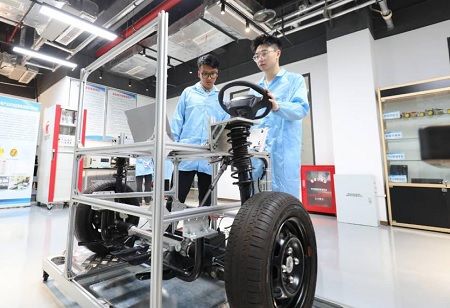
BYD, one of the world’s fastest-growing electric vehicle manufacturers, now employs more than 120,000 engineers. Between 2023 and 2025 alone, the company recruited over 50,000 fresh university graduates, with nearly 80 percent joining research and development roles. Around 70 percent of these recruits hold master’s or doctoral degrees.
According to BYD executives, the company’s strong training systems, flexible project assignments, and openness toward experimentation have helped young professionals quickly evolve into decision-makers leading core engineering projects.
For the KBS producers, the experience highlighted a major cultural difference. In many traditional corporate systems, major technical decisions are often dominated by senior leadership. At BYD, however, engineers in their twenties and thirties are directly involved in leading high-impact projects shaping the future of electric mobility.
The documentary team described this as one of the clearest examples of what many now refer to as 'China speed' the country’s ability to rapidly scale innovation through talent, infrastructure, education, and industrial coordination.
At the center of this innovation push is China’s relentless focus on solving some of the electric vehicle industry’s biggest challenges, especially charging speed and energy efficiency.
Near BYD’s Shenzhen headquarters, ultra-fast charging systems are already demonstrating the company’s latest technological breakthroughs. Engineers working on BYD’s pure electric platform have developed advanced flash-charging technology capable of significantly reducing charging time for EV users.
The company’s latest charging system can reportedly charge batteries from 10 percent to 97 percent in just nine minutes, placing it among the fastest EV charging technologies globally.
Much of this progress is being led by younger engineers like Cao Zhiyuan, a PhD graduate in electrical engineering who joined BYD in 2023 and now leads development work for overseas ultra-fast charging products.
Also Read: China and Central Asia Unite for a Future Powered by Education and Innovation
Inside BYD’s laboratories, engineers continuously conduct experiments, analyze data, and collaborate across teams to improve charging efficiency under different temperature and current conditions. According to company officials, ideas are judged based on technical verification and performance rather than hierarchy, creating an innovation-driven environment where young engineers can rapidly take ownership of major projects.
Industry experts believe this engineering-first culture has become one of the strongest forces behind China’s dominance in the global EV market.
China’s NEV industry has expanded at extraordinary speed over the past decade. When many of today’s young engineers entered the industry, annual NEV production in China was still relatively small. Today, the country produces more than 16 million NEVs annually, with electric vehicles accounting for more than half of all new car sales.
The transformation reflects not only industrial expansion but also the emergence of a deeply integrated innovation ecosystem supported by universities, research institutions, government strategies, and private companies.
Observers increasingly argue that China’s global EV leadership is no longer based solely on manufacturing cost advantages. Instead, it is now being powered by advanced engineering capabilities, rapid product development cycles, and a younger generation willing to experiment aggressively with next-generation technologies.
As global competition intensifies in electric mobility, battery systems, charging infrastructure, and clean transportation, China’s young engineering workforce is becoming one of the country’s most important strategic advantages.
The rise of companies like BYD demonstrates how engineering talent, innovation culture, and long-term industrial focus are collectively reshaping the future of the global automotive industry and positioning China at the center of the EV revolution.
🍪 Do you like Cookies?
We use cookies to ensure you get the best experience on our website. Read more...