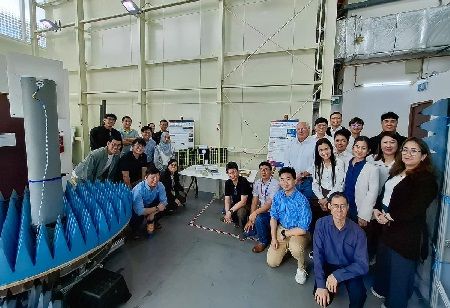
- Embry-Riddle Aeronautical University Asia hosted a three-day professional course on space operations for participants from Singapore, Thailand, the Philippines, Australia, and Brunei.
- The program, led by Dr. Andrew Aldrin, covered space commercialization, public-private partnerships, risk management, and the $570 billion global space economy.
- The course aims to prepare the next generation of space leaders and supports Singapore’s emerging role in regional space exploration, including the launch of its first national space agency.
As Singapore positions itself at the forefront of Asia’s growing space industry, Embry‑Riddle Aeronautical University’s Asia Campus recently hosted a professional course on space operations designed to prepare the next generation of leaders in the field. The three-day, in-person program, led by Dr. Andrew Aldrin, associate professor and executive director of space programs at Embry‑Riddle Worldwide, brought together professionals from academia, government, and industry across Singapore, Thailand, the Philippines, Australia, and Brunei.
Dr. Aldrin described the enthusiasm of the participants as one of the most rewarding aspects of the course. “The most exciting thing about this course was the level of enthusiasm and the opportunity for helping develop the future leaders of Singapore’s space programs”, he said. He added that Singapore has the potential to become a hub for space education in the Asia-Pacific region, leveraging its unique combination of economic, educational, and governmental resources.
The course, delivered in partnership with Space Faculty, a Singapore-based company focused on talent development in the space and deep-tech sectors, provided participants with interdisciplinary insights into space commercialization, public-private partnerships, risk management, and the projected growth of the $570 billion global space economy. Participants came from diverse professional backgrounds some with STEM expertise, others with experience in business or entrepreneurship reflecting the wide-ranging skills now required in the expanding space sector.
According to Jack Patel, academic officer and associate professor at Embry‑Riddle Asia, the program was designed to bridge gaps in knowledge for aviation professionals seeking to transition into space operations. Through lectures, discussions, and case studies, participants explored how policy decisions, economic models, regulatory frameworks, and international cooperation shape the trajectory of space development.
Also Read: UAC Joins Jinju City to Boost K-Entrepreneurship Worldwide
For attendees like Beatrice Toring, a university administrator from the Philippines, the course offered practical insights into how space initiatives affect life on Earth. “The course reframed space not as a distant frontier, but as a dynamic practical domain that directly affects life on Earth”, she said. Inspired by the program, Toring has initiated a 'Space on Earth' program at her university, emphasizing the importance of equipping students with knowledge that can improve disaster management, communications, navigation, climate monitoring, and economic growth.
The course also underscores Singapore’s emerging role in regional space exploration. The country will launch its first national space agency in April, focusing on research and development, industry growth, global partnerships, and the creation of policies for safety and sustainability. Embry‑Riddle Asia, meanwhile, has introduced a Space Studies minor and is exploring a full in-person master’s program to further strengthen the region’s space talent pipeline.
Dr. Aldrin noted that Singapore’s strong reputation in the U.S. and European space communities, combined with Embry‑Riddle’s established presence in aviation, creates exciting opportunities for collaboration. “Everyone I have spoken with is excited about the potential for collaboration with Singapore”, he said, emphasizing the university’s commitment to extending its expertise from aviation into the space sector.
The program represents a step toward developing a skilled workforce capable of navigating Asia’s rapidly evolving space economy, while demonstrating how education can transform abstract scientific frontiers into practical tools for national and regional development.