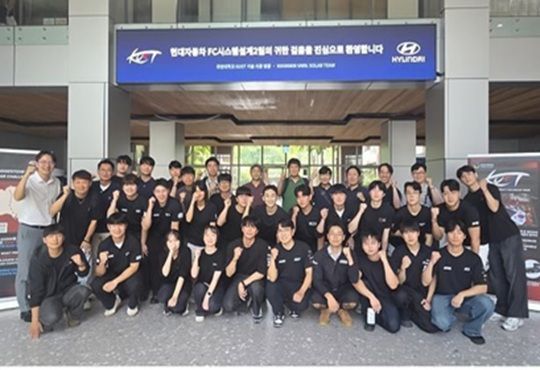
Kookmin University’s student solar car team has taken a significant step toward competing on the world stage. On 7 August 2026, members of the Kookmin University Solar Car Team (KUST) held a technical exchange meeting with engineers from Hyundai Motor at the university’s Seoul campus, receiving industry-level guidance as they prepare for the 2027 World Solar Challenge.
Eight Hyundai Motor staff members attended the session, including Park Jeong-hee, head of FC System Design Team 2. They were joined by Shin Dong-hoon, KUST’s faculty advisor and a professor of mechanical engineering at the university. The meeting focused on practical vehicle development issues that the student team faces while designing and building a competitive solar-powered car.
During the exchange, KUST students presented the design direction and key technical elements of the vehicle currently under development. They outlined their approach to energy management, structural design, aerodynamics and overall systems integration. Hyundai’s engineers reviewed the plans in detail and shared insights drawn from their own experience in advanced vehicle development, highlighting critical technical considerations that student teams often encounter when moving from concept to race-ready prototype.
The university confirmed that Hyundai Motor intends to maintain ongoing technical exchanges with KUST throughout the development process and the lead-up to the competition. The company plans to continue offering advice as the team refines its design, manufactures components and prepares for the demanding conditions of the race. KUST will incorporate the feedback received on 7 August directly into its vehicle development work.
The World Solar Challenge is one of the most prestigious international competitions for solar-powered vehicles. Held every two years in Australia, the event requires teams to drive approximately 3,000 kilometres across the Australian continent using only solar energy. University teams from around the world compete in categories that test vehicle design, manufacturing quality, energy efficiency and strategic race management. The next edition is scheduled for August 2027.
Also Read: Kookmin University Launches International Design Award In Milan
For Kookmin University, the project forms part of a broader institutional push into mobility-related education and research. As the university marks its 80th anniversary, it has designated mobility as one of eight specialised strategic areas. This focus encompasses automotive engineering, software, design and related fields, with an emphasis on expanding education, research and industry-academia collaboration.
KUST’s participation in the World Solar Challenge and its partnership with Hyundai Motor exemplify this strategy in action. The technical exchange gives students direct exposure to professional engineering practices while allowing them to apply classroom knowledge to a complex, real-world engineering challenge. Designing, building and racing a solar car requires expertise in multiple disciplines, including mechanical engineering, electrical systems, materials science, aerodynamics and energy management skills that align closely with the university’s mobility agenda.
The collaboration also reflects a growing trend in Korean higher education of linking student projects with major industry partners. By working with Hyundai Motor, one of the country’s leading automotive manufacturers, KUST gains access to specialised knowledge that is difficult to obtain in a purely academic setting. At the same time, Hyundai has the opportunity to engage with talented students who are developing next-generation vehicle concepts under competitive pressure.
University officials noted that the technical advice will be systematically applied as the team progresses through the design and build phases. The students must balance performance goals with the strict constraints of solar energy availability, vehicle weight, reliability and safety all while preparing for the extreme heat, long distances and variable weather conditions typical of the Australian outback route.
The 2027 World Solar Challenge will test not only the technical quality of the vehicle but also the team’s ability to manage energy, strategy and logistics over several days of continuous racing. Success in the event has historically depended on meticulous preparation, innovative design solutions and the capacity to adapt quickly to changing conditions on the road.
Kookmin University views the project as more than a competition entry. It sees the solar car initiative as a hands-on educational platform that develops students’ practical engineering skills, problem-solving abilities and experience in collaborative, multidisciplinary work. The ongoing relationship with Hyundai Motor strengthens that platform by providing sustained industry input throughout the multi-year development cycle.
As the team moves from the August technical exchange into the detailed design and manufacturing stages, the focus will shift toward turning concepts into a functional, race-ready vehicle. With Hyundai’s continued support and the university’s institutional backing through its mobility specialisation, KUST is positioning itself to represent South Korea on one of the world’s most demanding solar racing stages in 2027.
The meeting on 7 August marks an early but important milestone in that journey. For the students involved, it offered a rare opportunity to present their work to professional engineers and receive direct, actionable feedback. For the university, it demonstrated the value of linking ambitious student projects with industry expertise as part of a wider strategy to advance mobility education and research.