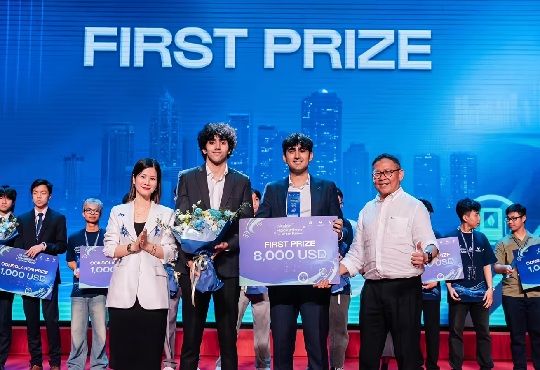
A two-member team from Singapore emerged victorious at the inaugural Asian Hackathon for Green Future 2026, outperforming hundreds of competitors from across the region in a prestigious competition focused on technology-driven solutions for sustainability.
Team Helios, comprising Pratham Ranjan and Alok Vernekar from Nanyang Technological University (NTU), Singapore, was crowned champion after presenting their innovative project titled 'An Urban Simulation Platform for Low-Carbon Infrastructure'.The team beat 439 competing teams and nearly 1,500 participants from 22 countries and territories.
The competition, jointly organized by three not-for-profit entities under Vingroup the 'For Green Future' Foundation, VinUniversity, and the Vingroup Young Technology Talent Club (VinTechTalent) concluded with its Final Round and Awards Ceremony on July 4 at VinUniversity in Hanoi.
Prof. Duong Nguyen Vu, Chair of the Competition’s Judging Panel and Vice Provost for Graduate Education at VinUniversity, along with Dr. Thai-Ha Le, Managing Director of the 'For Green Future' Foundation, Vingroup, presented the First Prize worth USD 8,000 to the winning team.
Team Helios’s solution addresses a pressing urban challenge: evaluating the real-world effectiveness of green infrastructure projects before cities commit substantial resources. Their district-level urban simulation platform allows planners to test various interventions such as EV charging stations, improved public transportation, solar energy integration, and climate-resilient designs while accurately forecasting impacts on travel behavior, carbon emissions, costs, and the power grid.
“This platform helps city authorities make informed, data-driven decisions, avoid ineffective investments, and accelerate the transition toward low-carbon urban environments,” the team explained.
The hackathon highlighted the growing need for cross-border collaboration in tackling Asia’s environmental challenges, which often transcend national boundaries. From climate change and energy transition to sustainable transportation and agriculture, the competition encouraged young innovators to develop practical, scalable solutions.
Second Prize, worth USD 5,000, went to Team VFluxion from the University of Information Technology, Vietnam National University Ho Chi Minh City. Their project focused on optimizing bidirectional charging for electric vehicles, enabling EVs to function not only as energy consumers but also as distributed energy storage units. This approach helps stabilize power grids, reduce reliance on high-emission backup sources, and extend battery life.
Two Third Prizes, each worth USD 3,000, were awarded to Vietnamese teams. Team Future Greener developed a comprehensive platform for tracking the lifecycle of EV batteries, promoting safer handling, repurposing, and recycling to support a circular economy. Team ALT F4 created an early warning system for saltwater intrusion that delivers timely alerts to farmers and officials, helping protect agricultural livelihoods from climate impacts.
Five Consolation Prizes of USD 1,000 each were also presented to teams from Vietnam, India, Singapore, and Hong Kong.
The journey to the finals was rigorous. From an initial pool of 439 teams submitting proposals and videos, the top 30 advanced to a month-long online training program with multidisciplinary experts. The finalists then participated in an intensive 36-hour on-site hackathon at VinUniversity, refining prototypes under the mentorship of Vingroup technology professionals.
Dr. Thai-Ha Le expressed pride in the event’s success, stating, “The Asian Hackathon for Green Future 2026 has shown that Vietnam can truly become a regional hub for Asia’s young talent in innovation for sustainable development. Cross-border ideas are not only shared but tested, refined, and transformed into practical solutions capable of creating lasting value for communities”.
Also Read: CityUHK Expands Global Ties with Leading Vietnamese Universities and Enterprises
The competition’s emphasis on real-world applicability stood out. Projects tackled diverse issues including energy systems, transportation, water resource management, and climate resilience all critical concerns across Asia.
Organizers noted that the hackathon successfully fostered collaboration among students from different academic backgrounds and nationalities. The training phase and intensive final round helped participants sharpen their problem-solving skills and develop functional prototypes ready for potential real-world implementation.
Looking ahead, the Asian Hackathon for Green Future is set to return in 2027 with expanded scale and broader geographical reach, aiming to attract even more young innovators from across Asia and beyond.
The inaugural edition has already positioned Vietnam as an emerging center for youth-led green innovation in the region. By providing a platform for ideas to be tested and refined, the hackathon contributes meaningfully to Asia’s collective efforts toward a more sustainable future.
As climate challenges intensify, initiatives like this play a vital role in nurturing the next generation of problem-solvers equipped with both technical expertise and regional perspective.