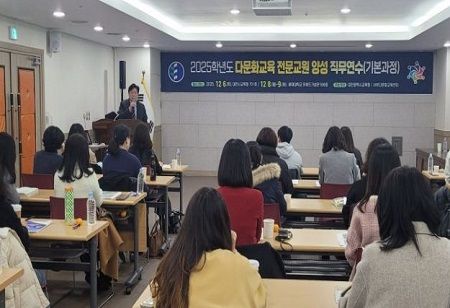
- Daejeon Office of Education held a Multicultural Education Specialist Teacher Training program from Dec 6-9.
- 39 teachers from kindergarten to high school participated, focusing on supporting students from migrant backgrounds.
- Program combined theory and hands-on exercises to enhance inclusive teaching and practical multicultural strategies.
Recently, the Daejeon Office of Education has undertaken a teacher training program of the widest possible scope, targeting teachers from various schools and kindergartens to help them understand and acquire the techniques and knowledge required to cater to the needs of these children. This 'Multicultural Education Specialist Teacher Training Program' was carried out at Pai Chai University's main building in the 701st conference room and Howard Memorial Hall from December 6 to December 9.
The program targeted 39 teachers in all stages of education, from kindergartens through elementary and middle schools up to high schools, demonstrating its aim toward inclusivity and understanding throughout the full spectrum of schooling. It was thus developed in response to the increased influx of students from migrant backgrounds and an overall increase in the countries of origin and languages represented by the students.
Since schools are increasingly being characterized by complex patterns of diversity each year, the development of focused strategies that will help to enhance their learning process, as well as adaptation into normal everyday life, has become an urgent issue. Thus, the training program should provide teachers with both theoretical and practical competencies to proactively address such new challenges that are emerging in educational settings.
Participants went through the policy and theory-based modules that covered a wide array of topics pertinent to multicultural education, such as understanding the dynamics of multicultural societies, navigating changes in educational policy, devising effective strategies for planning multicultural programs, and developing educational materials that promote multicultural understanding. By grounding teachers in these areas, the training aimed to enhance their ability to implement customized support systems tailored to the unique characteristics and needs of students from migrant backgrounds.
Also Read: CapitaLand Hope Foundation Supports Youth Education Across Asia
The program provided a strong emphasis on field-oriented training beyond theoretical instruction: educators participated in planning and feedback sessions concerning multicultural education programs, in hands-on consulting exercises, and in the creation of career education programs targeted for migrant students.
All these elements fully allowed participants to engage in real-life scenarios and school cases that were fostering skills immediately applicable in their professional environment. Experts brought in knowledge and expertise pertaining to the design of programs, counseling, and career planning in ways to ensure that teachers could take concepts and translate them into strategies right at their schools.
Cho Jinhyung, the Director of Secondary Education at the Daejeon Office of Education, discussed the critical need for professional development in this area. He stated that, given the fact that there will be an increasing number of students from migrant backgrounds, teachers need to obtain knowledge that would allow them to respect their students' diversity and offer real support with respect to schoolwork and daily life.
He said that he felt the training would allow schools to provide more systematic and efficient multicultural education programs and thus help realize a more inclusive and supportive educational environment for all students. This initiative underlines the proactive attitude of the Daejeon Office of Education toward multicultural education, reflecting a greater commitment to inclusiveness, equity, and professional growth for teachers in dealing with the increasing diversity found in today's schools.