
How Malaysia/Vietnam Are Democratizing Research Education Access

-
- Research education is becoming accessible to all learners
- Universities and businesses co-create research with early commercialization
- Micro-credentials and blockchain portfolios scale research regionally
As Southeast Asia accelerates toward high-income status, Malaysia and Vietnam are executing two of the region's most audacious experiments in higher education. They're not simply expanding access to university they're democratizing research itself, transforming it from an elite pursuit into a foundational skill accessible to millions, including vocational learners, rural youth, mid-career professionals, and underrepresented groups.
This isn't incremental policy tweaking. Malaysia's National Education Plan 2026–2035 and Vietnam's sweeping 2025-2026 education law amendments(effective January 2026) embed research competencies into everyday learning pathways, fuse universities with industry ecosystems, and leverage digital infrastructure to erase traditional gatekeepers.
The outcome, research becomes a portable, monetizable asset rather than a luxury degree add-on.
From Elite Gatekeeping to Mass Research Competency
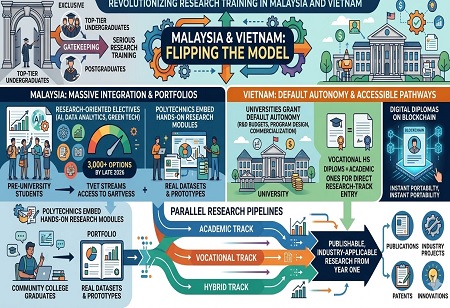
Traditional models reserve serious research training for top-tier undergraduates or postgraduates.
Malaysia and Vietnam flip this entirely:
Malaysia integrates research-oriented electives (AI, data analytics, green tech) into pre-university and TVET streams, with 3,000+ options by late 2026. Polytechnics now embed hands-on research modules, allowing community college graduates to enter university programs with portfolios of real datasets and prototypes.
Vietnam grants universities default autonomy in R&D budgeting, program design, and commercialization. Vocational high-school diplomas now equate to academic ones for direct research-track entry. Digital diplomas on blockchain ensure instant credential portability.
These moves create parallel pipelines, academic, vocational, and hybrid each feeding into publishable, industry-applicable research from year one.
Prime Minister Anwar Ibrahim emphasized this urgency in launching Malaysia's plan, new technologies and STEM must be embraced immediately to avoid falling behind.
The Game-Changing Business Innovation
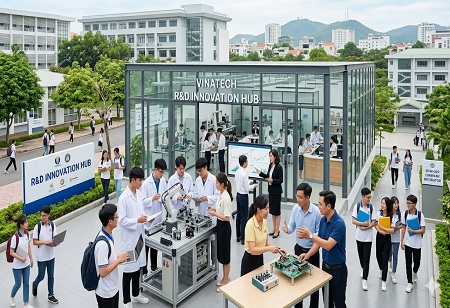
The boldest element is treating businesses as equal partners in research training not just recruiters.
Vietnam's amendments legally enable enterprises to:
- Build on-campus R&D centers with tax/land incentives
- Deploy staff as lecturers
- Fund scholarships via a dedicated Human Resource Training Fund
- Co-own spin-offs from student/faculty inventions
Malaysia advances public-private models, co-designed electives, 5,000+ new affordable residences tied to industry hubs, and free education for 3,000+ disabled students including lab/research access.
This creates a flywheel, companies invest in talent pipelines → students gain paid research internships → outputs feed commercialization → universities gain funding and relevance.
It's a self-reinforcing ecosystem where research skills generate immediate economic value.
A senior education leader in Vietnam noted the shift: businesses setting up campus R&D labs and encouraging spin-offs commercialize inventions directly.
Fresh, Scalable Models Emerging Right Now

These reforms birth genuinely novel approaches other Asian nations can replicate:
Research Micro-Credentials Funded by Industry Levies: Stackable 6-12 month modules co-created with enterprises, delivered digitally, and subsidized through training funds. Graduates exit with verifiable research outputs (e.g., published case studies, patents filed) plus employer endorsements bypassing full degrees.
Equity-Style Student Participation in Campus Spin-Offs: Students contributing to industry labs receive equity-like stakes in resulting ventures. This turns research from academic exercise into personal wealth-building, attracting non-traditional learners motivated by entrepreneurship.
ASEAN Research Passport via Blockchain: Portable digital portfolios aggregating research micro-credentials, publications, and industry projects recognized regionally. Vietnam's national blockchain diploma system + Malaysia's open platforms provide the infrastructure.
Hybrid Vocational-Research Tracks with Early Commercial Exposure: Vocational students enter university research programs directly, participating in enterprise-funded projects from semester one compressing the timeline from learner to innovator.
Also Read: Best Models for Building Research Skills in PhD Programs
Top 5 Leading Institutions Driving the Transformation in 2026

These universities exemplify the new paradigm through aggressive autonomy, industry fusion, and inclusive research scaling:
- Universiti Malaya (Malaysia) - Flagship with expanded AI/data electives, strong industry-linked residences, and inclusive free-access programs boosting research participation among diverse groups.
- Vietnam National University, Ho Chi Minh City (VNU-HCM) - Aggressive talent attraction (350+ global scientists target by 2030), trilateral university-business-government research, aiming for Asia top-100 status.
- University of Economics Ho Chi Minh City (UEH, Vietnam) - Tops Vietnamese rankings (THE 501–600 globally), excels in industry-aligned research and employability-focused innovation.
- Sunway University (Malaysia) - Dramatic QS Asia climb (100+ places), powered by 600+ global industry ties, joint research, and digital platforms democratizing access.
- HUTECH (Ho Chi Minh City University of Technology, Vietnam) - Rapid rise to Vietnam's top 4 in SCImago 2026, strong in applied research, tech commercialization, and vocational-research integration.
Winding It Up!
As 2026 unfolds, watch these two nations closely. They're not just reforming education they're engineering a more equitable, dynamic research economy. The blueprint is live, proven, and ready for export across ASEAN and beyond. The question for the rest of the region, follow, adapt, or risk being left behind in the talent race.
🍪 Do you like Cookies?
We use cookies to ensure you get the best experience on our website. Read more...