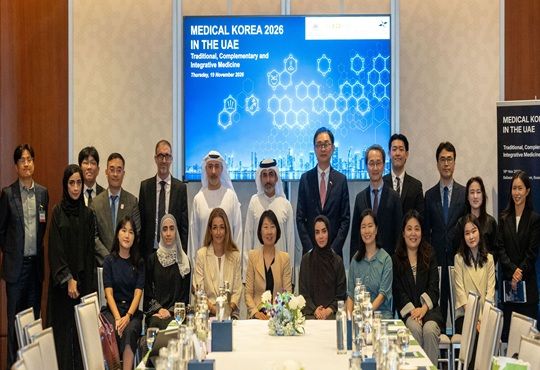
The United Arab Emirates (UAE) and the Republic of Korea are exploring opportunities to strengthen cooperation in traditional, complementary and integrative medicine, focusing on education, clinical training and scientific research. Experts and academics from both countries discussed ways to expand knowledge exchange, develop educational partnerships and promote evidence-based healthcare practices during the Medical Korea 2026 in the UAE: Traditional, Complementary and Integrative Medicine seminar.
Held on Thursday, November 19, at Rosewood Abu Dhabi, the seminar was jointly organised by the Embassy of the Republic of Korea to the UAE, the Korea Health Industry Development Institute (KHIDI) UAE office and the Zayed Complex for Herbal Research and Traditional Medicine (ZHC). The event brought together healthcare professionals, academic representatives, researchers and institutional stakeholders to explore opportunities for bilateral collaboration.
Participants included Dr. Ghanem Ali Al Hassani, Executive Director of ZHC; Dr. Mohammed Al Olama, Director of the Research and Laboratory Department at ZHC; and Professor Byungchul Lee, Dean of the College of Korean Medicine at Kyung Hee University. Representatives from Khalifa University, United Arab Emirates University, the University of Sharjah, Kyung Hee University Korean Medicine Hospital and the National Development Institute of Korean Medicine (NIKOM) also attended.
Addressing the gathering, Lee Won-ik, Ambassador of the Republic of Korea to the UAE, highlighted the growing strategic relationship between the two countries and the importance of healthcare cooperation. He noted that healthcare is one of the key pillars of the UAE-South Korea Special Strategic Partnership, with traditional medicine emerging as a new area of collaboration.
The ambassador emphasised the importance of preserving traditional medical heritage while ensuring the safety and effectiveness of its practices through scientific evidence. He also expressed hope for expanded cooperation in documenting and scientifically studying Emirati traditional medicine, alongside opportunities to train future specialists in integrative medicine.
Education and research emerged as important themes throughout the seminar, particularly in developing academic frameworks that connect traditional medical knowledge with contemporary healthcare practices. Participants discussed educational models that support safe, evidence-based approaches to traditional, complementary and integrative medicine.
Also Read: Eulji Univ Holds Int'l Nursing Conference on Advanced Practice Roles
The Korean delegation presented an overview of South Korea's traditional medicine system, including the academic curriculum followed by Kyung Hee University's College of Korean Medicine. The programme combines traditional medical knowledge with modern medical education, offering students an integrated understanding of healthcare practices. The delegation also introduced the university's international educational programmes, highlighting opportunities for academic engagement and professional knowledge exchange.
The discussions also covered research on camel milk and diabetes, the therapeutic potential of local medicinal plants and natural resources, and the importance of their safe and sustainable use. These topics highlighted opportunities for scientific investigation into traditional healthcare knowledge and its potential applications in contemporary medicine.
For the UAE, documenting traditional medical practices and studying locally available medicinal resources through scientific research could contribute to preserving its healthcare heritage while supporting evidence-based applications. South Korea's experience in developing traditional medicine education and clinical systems also offers opportunities for knowledge exchange, particularly in curriculum development, professional training and research methodologies.
The participation of universities and specialised healthcare institutions from both countries provided a platform to explore collaborative initiatives that extend beyond traditional medical practices. Discussions focused on strengthening institutional partnerships, encouraging joint research and creating opportunities for educational exchanges between academic and healthcare organisations.
The seminar concluded with participants identifying potential areas for future cooperation, including joint research projects, academic exchanges and continued collaboration in traditional, complementary and integrative medicine.
The discussions reflect the growing interest of both countries in connecting traditional medical heritage with modern scientific research and education. Through stronger academic partnerships, clinical training and knowledge exchange, the UAE and South Korea aim to support the development of safe and scientifically supported integrative medicine practices.