
-
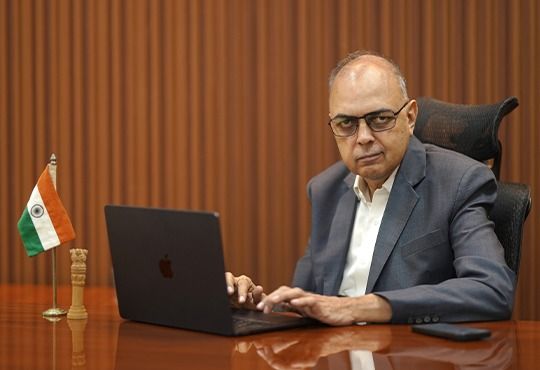
Dhananjaya Sudhanva has led Excelsoft Technologies, a global education and assessment technology company, since co-founding it in 2001 and building it from Mysuru, Karnataka, for over two decades. Sudhanva holds a Master's in Electrical Engineering from Worcester Polytechnic Institute and an MBA in Engineering Management. Under Sudhanva's leadership, Excelsoft has built large-scale digital assessment systems used across schools, universities, and professional certification bodies worldwide, including deployments in remote and infrastructure-constrained regions. Beyond Excelsoft, Sudhanva co-founded Excel Public School, chairs the Excel Empathy Foundation, and serves as President of TiE Mysuru, reflecting a long-standing commitment to education and entrepreneurship.
In an interaction with M R Yuvatha, Editor, Asia Education Review, Dhananjaya shares insights on the future of high-stakes assessment in education.
For over a century, the examination hall has played two contradictory roles in education systems worldwide the great equalizer, offering every candidate the same shot at opportunity regardless of background, and the great gatekeeper, deciding who advances and who does not. As assessment moves from paper to screen, from invigilators to algorithms, the education sector faces a harder question than whether the technology works: does it make the system fairer, or does it simply move the same old inequities somewhere harder to see?
Digital assessment has expanded rapidly across schools, universities and certification bodies over the past decade, reshaping how millions of students are tested each year. From urban exam centres to remote schools with unreliable power and connectivity, the shift has raised as many questions as it has answered. A recent industry conversation on the future of highstakes assessment explored where digital testing is succeeding, where new risks are emerging, and what a genuinely 21stcentury exam should look like offering a rare, groundlevel view of how largescale assessment platforms are built, secured and made fair across some of the world's most demanding testing environments.
Digitisation Alone Does Not Create Fairness
Moving an examination from paper to a screen does not, on its own, make the process fairer. Technology can improve consistency, security and reach, but fairness ultimately depends on how an assessment is designed and administered not merely on the device delivering it.
The real test for any modern examination system is whether candidates are given a genuinely comparable opportunity to demonstrate what they know. That extends well beyond the screen: the quality of the questions being asked, whether different versions of an exam are equally difficult, how well the system accommodates candidates with different needs, the availability of language support, the realities of connectivity in different regions, and whether a fair mechanism exists to review decisions when something goes wrong.
In largescale testing programmes, running every candidate through a single exam session is often simply not feasible, and multiple sessions become unavoidable. In such cases, fairness cannot mean that every candidate sees exactly the same questions; it has to mean that different versions of the exam are calibrated to offer a comparable level of challenge. Digital systems offer far stronger tools than paper ever could to manage this scientifically, through structured question banks, statistical calibration and consistent administration protocols across test centres, languages and time zones.
Technology in assessment should help bridge gaps between students caused by unequal access to devices, internet, and infrastructure, rather than creating new disparities based on the resources available to them.
A fair assessment, ultimately, reflects a candidate's preparation and performance rather than a candidate's location, infrastructure, or the particular session in which the exam happened to be taken. As education systems scale digital testing to millions of students annually, this distinction between fairness as a technical feature and fairness as a designed outcome becomes central to how the sector should evaluate its own progress.
Where AI Should Assist and Where It Must Not Decide
Artificial intelligence can now grade essays, flag anomalies in candidate behaviour, and monitor testtakers in real time. The line between AI assisting human judgment in assessment and AI replacing it comes down to one factor: the consequence of the decision being made.
AI carries genuine value in assessment. It can identify patterns, support evaluators, flag unusual activity, and make large volumes of data manageable for human reviewers. Used this way, AI improves consistency and directs human attention to where it is most needed, rather than spreading scrutiny evenly and inefficiently across every candidate session.
But detecting an anomaly is not the same as understanding it. A behavioural signal, an unusual response pattern, or a connectivity interruption can have more than one explanation. When a decision has the potential to invalidate an exam, alter a score, or affect a candidate's academic or professional future, a higher standard of accountability has to apply one that a purely automated system cannot, on its own, satisfy.
In largescale deployments, AI has proven most valuable in helping reviewers identify the relatively small portion of a much larger examination session that genuinely warrants scrutiny. That is a very different role from allowing the technology itself to determine whether misconduct occurred. Human involvement matters in highstakes assessment not because human judgment is always more accurate than machine output it frequently is not but because consequential decisions need to be explainable, reviewable and owned by an accountable person within the institution.
The more useful question for education technology providers, then, is not how much of assessment can be automated, but where automation genuinely improves the quality of a decision, and where human responsibility has to remain central to preserve trust in the outcome.
The Integrity Arms Race Has Moved Upstream
Exam fraud once meant smuggled notes and impersonation. Today, it can mean deepfakes, AIgenerated answers, and remote collusion operating at scale. The central lesson of this shift for education institutions is that assessment integrity can no longer be treated as an examday problem alone.
In a digital assessment pipeline, a single question can pass through authoring, review, translation, question banking, assembly, distribution and final delivery before it ever reaches a candidate and every one of those stages needs protection. A secure examination depends on how well the entire process is controlled, not simply on how closely a candidate is monitored during the test itself.
That reframing changes how education institutions need to think about security altogether. Identity verification, access control, secure content handling, controlled delivery, anomaly monitoring and reliable audit trails all play a role in a modern assessment security model. Resilience matters just as much: a welldesigned assessment system should not be so fragile that a single compromised question, malfunctioning device or affected test centre threatens the integrity of an entire examination cycle.
Many of the most consequential security decisions in highstakes testing are made long before a candidate ever sits down to take a test. Examday technology, in this framing, is only one part of a much larger picture that spans content creation, warehousing and delivery infrastructure. As AI grows more capable of producing crediblesounding answers, assessment itself must evolve in response shifting institutional emphasis away from what candidates can reproduce and toward how candidates apply knowledge, reason through problems and demonstrate genuine capability under examination conditions.
Treating Access to Assessment as Seriously as Access to Education
Millions of capable students remain effectively excluded from highstakes assessments simply because of where they live, without reliable power, internet access, or a nearby test centre. A fair assessment system must start by recognising that candidates sit for exams under very different conditions, and that geography, language, disability or infrastructure should never determine who gets the opportunity to prove what they know.
The answer for education systems is not to lower standards but to design assessment infrastructure capable of maintaining those standards across a much wider range of environments. In one publicschool assessment programme spanning remote island schools, examinations were centrally administered across dispersed locations, delivered in multiple languages, and independently evaluated to preserve consistency across every test site. In another highstakes assessment environment, the underlying platform was engineered to preserve candidate responses through connectivity or power interruptions, synchronising them securely once services were restored.
Newer solutions extend this thinking further. Purposebuilt examination appliances now help institutions set up secure, resilient digital testing centres in locations where internet connectivity or conventional IT infrastructure remains limited, running exams locally while still supporting centralised governance and reporting a model particularly relevant for remote, rural or temporary test centres in developing education markets.
"A candidate in a remote location should be able to sit an examination held to standards just as credible as those available in a major city."
Difficult infrastructure conditions do not have to translate into weaker assessment standards, provided systems are designed around the conditions candidates actually face rather than assuming ideal infrastructure everywhere. Technology alone is not sufficient for this goal; an operational responsibility remains for education authorities to ensure properly equipped, audited assessment centres exist within reasonable reach of every candidate population, urban or remote.
What Institutions Should Weigh Before Deploying Smarter Proctoring
Contextual proctoring, biometric verification and behavioural analytics all help secure an exam, but they also generate substantial amounts of data about the students being assessed. The purpose of proctoring in education should be to establish confidence in an examination's integrity, not to observe candidates simply because the technology makes deeper observation possible. More data does not automatically translate into better evidence; context, proportionality and human review remain critical safeguards.
Before expanding proctoring capability, education institutions and assessment providers should weigh several factors carefully:
- Necessity and proportionality of every data signal being collected
- Clear disclosure to candidates on what is collected, why it is required, and how long it is retained
- Contextual interpretation of signals rather than singleindicator judgment
- A defined rule and evidence threshold before any score is cancelled
- Mandatory human review for every misconductrelated decision
- A genuine, accessible appeal mechanism for candidates to challenge outcomes
This becomes especially important in remote examinations, where proctoring systems may be observing a candidate's private home environment rather than a purposebuilt examination centre. A candidate looking away from the screen, an unexpected sound, an unusual interaction pattern, or a temporary connection failure may warrant a closer look, but none of these signals automatically establishes misconduct on their own.
Individual signals become far more meaningful in education assessment when interpreted in context and weighed alongside other evidence multiple indicators may reinforce one another, while an isolated event may have a perfectly legitimate explanation rooted in a candidate's home or network conditions.
Also Read: Rethinking Talent Development in an Era of AI and Global Collaboration
Designing the Exam of the Future from a Blank Page
Asked how the highstakes exam might be redesigned with no legacy systems and no institutional inertia, the response centred on one unchanged constant: education systems still need a credible way to determine whether someone has demonstrated a required level of knowledge or competence. What would change is everything built around that core purpose.
What a candidate experiences on exam day is only a small part of what ultimately determines whether an examination can be trusted by students, institutions and employers alike. Many of the decisions that shape security, fairness and reliability are made much earlier, in how questions are created, reviewed, stored, assembled and controlled, and they continue afterward through evaluation and audit.
Built from scratch, a modern assessment process would function as one connected system rather than a series of disconnected examday procedures. Security would begin at the moment a question is created, not when a candidate arrives at a test centre. Accessibility would be considered from the outset rather than retrofitted after deployment. The system would be engineered to function reliably across varied infrastructure conditions, from major cities to remote districts. AI would be deployed wherever it improves consistency or supports better decisions, while consequential decisions would remain explainable and accountable to identifiable people within the institution.
The sophistication should sit behind the scenes so the candidate can focus on demonstrating capability.
Such a system would also be designed with the explicit expectation that something will eventually go wrong a network will fail, a device will malfunction, a single question will be compromised. A mature assessment architecture should be able to contain such failures rather than allowing one local problem to invalidate an entire examination cycle affecting thousands of students. Crucially, candidates themselves should not have to experience any of this underlying complexity; for the person sitting the exam, the experience should actually become simpler, with the sophistication of security, accessibility, reliability and consistency operating entirely behind the scenes.
A More Trustworthy Future for HighStakes Assessment
Across every theme in this conversation, a consistent principle emerges for education technology, digital tools are not a substitute for good assessment design, but an amplifier of whatever design choices sit beneath them. Digitisation, AI and biometric verification can each make examinations more consistent, secure and accessible or they can quietly reproduce and accelerate the same inequities that have shadowed highstakes testing for a century, simply in a less visible form.
The future of assessment is not about replacing paper with screens or layering on more artificial intelligence for its own sake. It is about building an examination ecosystem that offers every candidate a genuinely fair opportunity, functions reliably across vastly different conditions, safeguards integrity from question creation through to final audit, and keeps identifiable people accountable for decisions that can shape a student's academic or professional future. As AI grows more capable of mimicking human performance, education systems will also need to rethink what they test in the first place placing far greater weight on how candidates apply knowledge, reason through problems, and demonstrate realworld capability rather than simple recall.
In The End!
The measure of any assessment system in education is not how advanced its underlying technology is, but whether students, institutions and employers can trust the result it produces.
🍪 Do you like Cookies?
We use cookies to ensure you get the best experience on our website. Read more...