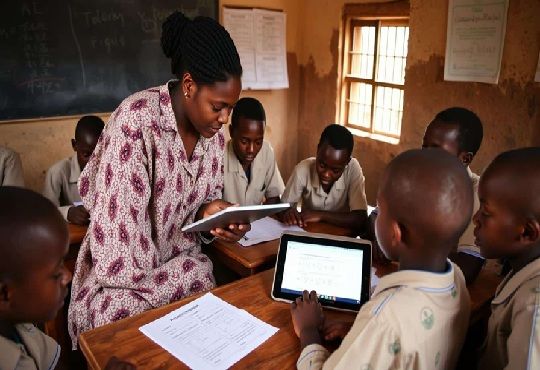
Nigeria has taken a significant step toward modernizing its education system by launching a digital skills training initiative for teachers, even as the country continues to battle a chronic and severe shortage of educators.
The Federal Ministry of Education commenced a three-day workshop in Abuja focused on the use of mobile technologies in education. The program aims to train 2,000 teachers and school leaders in digital competencies, marking an important effort to bridge the technological gap in Nigerian classrooms.
The initiative is a collaborative effort between the Nigerian government, the Japanese government, and several international partners including the UNESCO International Institute for Capacity Building in Africa (UNESCO-IICBA), the Pan African University (PAU), and Castalia Co. Ltd., a Japan-based consulting firm specializing in education system modernization. It forms part of the broader Pan-African Virtual and E-University (PAVEU) project.
Participants are receiving training in digital literacy, artificial intelligence applications in education, gender-responsive teaching methods, and the use of the GOKU Mobile Learning platform a mobile-friendly solution designed to function effectively even in areas with limited connectivity.
Japan is providing substantial support, contributing nearly $1 million to the program along with 40 tablets and two edge computing devices to facilitate hands-on training. Uchenna Uba, Director of Colleges of Education, who represented Minister of State for Education Suwaiba Sa'id Ahmad, described the workshop as a critical step toward improving education quality and aligning with the Nigeria Education Sector Renewal Initiative (NESRI).
“The training will create a multiplier effect across the country", Uba stated, explaining that trained teachers will subsequently train their colleagues in selected schools nationwide.
Despite the promising initiative, experts caution that the program’s scale remains modest compared to the enormity of the challenge. The 2,000 teachers targeted represent less than 0.5% of Nigeria’s total teaching workforce. The success of the program will heavily depend on the effectiveness of its train-the-trainer model and the ability to overcome infrastructural barriers such as unreliable internet connectivity in many regions.
The digital training launch comes against the backdrop of a persistent and structural teacher shortage. According to the Universal Basic Education Commission (UBEC), Nigeria currently has 915,593 primary school teachers serving approximately 31.8 million students resulting in a student-to-teacher ratio of 35:1, significantly higher than UNESCO’s recommended 25:1.
The Teachers Registration Council of Nigeria (TRCN) and UBEC estimated a teacher deficit of around 278,000 in 2025. The situation is further aggravated by the emigration of qualified educators, with over 2,600 Nigerian teachers recruited by the United Kingdom and Canada between 2022 and 2024 alone.
Also Read: AI Literacy: The New Core Competency for Education Leaders
Nigeria’s education budget has also remained consistently low, fluctuating between 5% and 9% of total government expenditure well below UNESCO’s recommended benchmark of 15% to 20%.
Stakeholders believe that while initiatives like this digital training program are essential for preparing teachers for 21st-century classrooms, they must be accompanied by broader efforts to address the fundamental issue of teacher recruitment, retention, and welfare.
The program reflects a growing continental push to integrate technology into African education systems. Similar efforts are being observed across several countries as governments seek to improve learning outcomes through digital innovation despite resource constraints.
As the workshop concludes, education officials are optimistic that the trained teachers will serve as catalysts for wider digital transformation in Nigerian schools. However, long-term success will depend on sustained funding, infrastructure development, and comprehensive strategies to resolve the underlying teacher shortage crisis.
For Nigeria, balancing the urgent need for more teachers with the equally important demand for digitally skilled educators remains one of the most pressing challenges in its education sector renewal journey.