
-
As families across the United Arab Emirates prepare for the return to classrooms, the National Programme for Artificial Intelligence, in partnership with the National Programme for Coders, has launched the eighth edition of the UAE AI Camp. Running from 17 to 29 August 2026, the intensive programme arrives at a pivotal moment in the academic calendar, equipping school and university students, young people, employees, SME owners and technology enthusiasts with practical skills in artificial intelligence, programming and emerging technologies.
The camp forms part of the UAE Government’s sustained drive to expand the national talent pool capable of keeping pace with rapid technological change and to support the transition toward a more competitive, sustainable knowledge-based economy. By timing the programme just as the new school year approaches, organisers aim to give participants an early advantage: the ability to apply AI tools and computational thinking directly to their studies, projects and future careers.
Dr. Abdulrahman Al Mahmoud, Director at the UAE Government’s Artificial Intelligence Office, underscored the urgency of continuous upskilling. “The rapid advancement of artificial intelligence technologies requires educational platforms that evolve just as quickly”, he said. “Investing in talent development strengthens innovation and enhances society’s readiness for the future”. His remarks highlight a core principle of UAE policy that human capital remains the country’s most strategic resource in the age of AI.
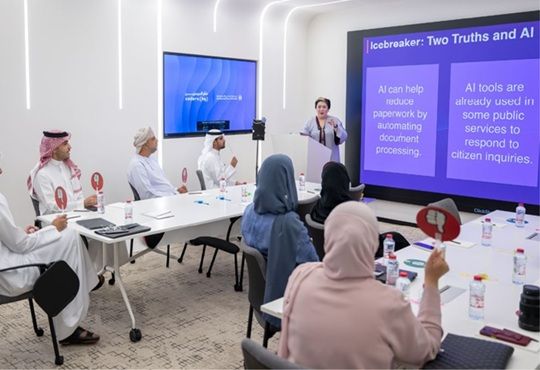
Participants will engage in a series of new workshops designed to move beyond theory. Sessions focus on turning ideas into working applications that address real-world challenges, from smart education tools and data-driven decision-making to solutions that support sustainability and economic competitiveness.
The curriculum deliberately spans age and professional groups so that secondary-school students, university undergraduates, early-career professionals and entrepreneurs can all find relevant pathways. This inclusive approach reinforces the camp’s position as a national platform rather than a narrow training course.
For school-age participants, the timing is especially significant. Returning to classrooms with foundational AI literacy and coding experience can transform how students approach science, technology, engineering and mathematics subjects, as well as creative and business projects. Teachers and parents increasingly recognise that familiarity with machine-learning concepts, data analysis and algorithmic thinking will become as essential as traditional digital skills. The camp therefore functions as both a summer intensive and a bridge into the new academic year.
University students and recent graduates stand to gain practical project experience that strengthens portfolios and employability. In a labour market where demand for AI-related roles continues to rise, hands-on exposure to current tools and methodologies offers a competitive edge. SME owners and employees, meanwhile, can explore how AI can improve operational efficiency, customer engagement and product development — capabilities that support the UAE’s broader ambition to nurture a vibrant private-sector innovation ecosystem.
The programme also reflects deeper policy priorities. By pairing the National Programme for Artificial Intelligence with the National Programme for Coders, the government signals that AI competence and coding fluency are inseparable. Coding remains the language through which many AI systems are built, trained and deployed; equipping citizens with both skill sets accelerates the translation of research into deployable solutions. Over successive editions the camp has refined this dual focus, steadily raising the sophistication of workshops and the quality of partnerships with global technology organisations.
Global partnerships form another pillar of the 2026 edition. Collaboration with international experts and institutions ensures that content stays aligned with worldwide best practice while remaining relevant to local priorities. Participants therefore benefit from exposure to cutting-edge techniques without losing sight of the UAE’s specific development goals among them the creation of practical applications that reinforce the country’s leadership in advanced technology.
Beyond individual skill-building, the camp contributes to a wider cultural shift. When students, young professionals and entrepreneurs leave the programme with the confidence to experiment, prototype and iterate, they become agents of innovation in their schools, workplaces and communities. This multiplier effect is essential for a nation that aims not merely to adopt AI but to shape its responsible and impactful use.
The emphasis on practical outcomes distinguishes the UAE AI Camp from purely theoretical programmes. Organisers stress the transformation of ideas into applications that can support national objectives, whether in education, resource management, healthcare, logistics or creative industries. In an economy increasingly defined by data and algorithms, the ability to move from concept to functioning prototype is a critical differentiator.
As the August dates approach, registration and preparation activities are already under way. The inclusive targeting of multiple demographic groups maximises reach and ensures that the benefits of AI literacy are distributed across society rather than concentrated in a narrow technical elite. This democratic approach to talent development aligns with the UAE’s long-standing commitment to broad-based human capital investment.
Looking ahead, the skills acquired during the two-week intensive will continue to pay dividends throughout the academic year and beyond. Students returning to school will carry new analytical tools and a problem-solving mindset shaped by AI concepts. Young professionals will apply fresh techniques in their workplaces. Entrepreneurs will explore new product and service opportunities. Collectively, these individual gains strengthen the national innovation system and reinforce the UAE’s position as a regional and global hub for advanced technology.
Also Read: How Industry-Academia Ties Are Powering UAE STEM Education
The launch of the eighth edition therefore represents more than the opening of another training programme. It is a timely intervention at the threshold of the school year, a concrete expression of government policy, and a practical investment in the generation that will shape the UAE’s technological future. By combining rigorous workshops, inclusive participation and a clear focus on real-world application, the UAE AI Camp 2026 continues to fulfil its role as a cornerstone of national AI capacity building.
In a world where artificial intelligence is reshaping every sector, the ability to understand, apply and innovate with these technologies is no longer optional. The UAE’s decision to place talent development at the centre of its AI strategy, and to deliver that development through accessible, high-quality programmes timed to the rhythm of the academic calendar, offers a model of forward-looking education policy. As participants begin their journey on 17 August, they step into a programme designed not only to teach skills but to cultivate the mindset required for leadership in the knowledge economy.
🍪 Do you like Cookies?
We use cookies to ensure you get the best experience on our website. Read more...