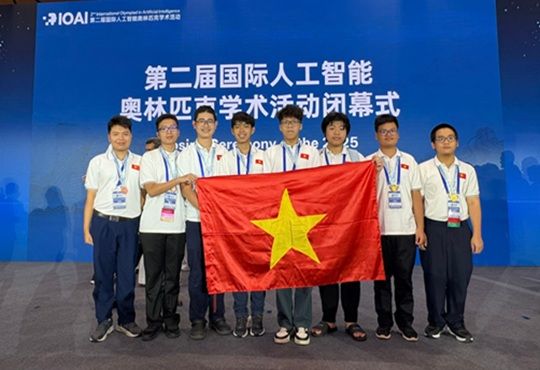
Vietnam has delivered an impressive performance at the third International Olympiad in Artificial Intelligence (IOAI), with seven of its eight contestants claiming medals in the global competition held from 2 to 8 August 2026.
The Vietnamese team collected two gold medals, one silver and four bronze, according to the Ministry of Education and Training (MoET). The result places the country among the stronger performers at an event that attracted 471 students from 108 teams representing countries and territories worldwide. Organisers awarded a total of 37 gold, 73 silver and 110 bronze medals.
The two gold medallists are Nguyen Viet Trung Nhan, an 11th-grade student, and Nguyen Huu Tuan, a 12th-grader. Both attend the High School for Gifted Students under the University of Science, Vietnam National University, Hanoi. Their schoolmate Nguyen Anh Hung, also in 11th grade, secured the silver medal.
Bronze medals went to four students from different regions: Phan Dinh Triet, a 12th-grader from Le Quy Don High School for the Gifted in Da Nang; Le Minh Quan, a 12th-grader from Quang Trung High School for the Gifted in Dong Nai; Ha Gia Minh, an 11th-grader from the same Hanoi gifted school; and Nguyen Le Duy Khang, a 10th-grader from Le Hong Phong High School for the Gifted in Ho Chi Minh City.
The achievement underscores Vietnam’s growing competitiveness in artificial intelligence at the secondary-school level. Officials noted that the medals reflect not only individual talent but also the quality of the country’s general education system as it implements Politburo Resolution No. 57-NQ/TW, which prioritises breakthroughs in science, technology, innovation and national digital transformation.
This year’s IOAI required contestants to complete the full artificial-intelligence problem-solving process. Students had to handle data analysis, write programmes, train and optimise models, test solutions and deliver finished work. Success demanded strong skills in programming, algorithms, statistics and computing, together with solid knowledge of machine learning and AI concepts.
For the first time, the Ministry of Education and Training organised a structured two-round national selection process to form the team. An initial online test drew 1,188 students from 34 provinces and cities. From that group, 246 advanced to a second-round in-person AI programming examination. The eight highest performers were then chosen to represent Vietnam in Kazakhstan.
The rigorous selection and the subsequent international results highlight the depth of talent emerging from Vietnam’s specialised high schools for gifted students. These institutions have long emphasised mathematics, informatics and scientific thinking; the addition of structured AI training appears to be yielding measurable outcomes on the global stage.
Education officials described the medals as affirmation of Vietnamese students’ aptitude, analytical ability and readiness to engage with new technologies. In a period when artificial intelligence is reshaping economies and education systems worldwide, early success in international competitions helps signal national capacity and motivates further investment in STEM and digital skills.
The third edition of the IOAI continues a relatively young but rapidly growing competition that tests practical AI capabilities rather than purely theoretical knowledge. By requiring participants to move through the entire pipeline from data to deployed model, the contest mirrors real-world AI development more closely than traditional programming olympiads.
Vietnam’s near-complete medal haul seven awards from eight participants stands out in a field of more than 100 teams. It also builds on the country’s broader efforts to strengthen science and technology education in line with long-term national strategies. Resolution 57 has placed particular emphasis on developing human resources capable of driving innovation and digital transformation; results such as these provide early evidence that the policy direction is producing capable young talent.
Also Read: UAE AI Camp 2026 Preps Students for Back-to-School Tech Future
Looking ahead, the success is expected to encourage more schools and provinces to invest in AI-related extracurricular programmes and competitions. The two-round selection model introduced this year may become a regular pathway, giving a larger pool of students the chance to test themselves against national and international standards.
For the medallists themselves, the experience offers more than recognition. Exposure to high-level problem sets, international peers and the full cycle of AI development provides valuable preparation for future university studies and careers in technology, research or related fields.
The Ministry of Education and Training has presented the outcome as both a sporting-style achievement and a broader indicator of educational progress. In an increasingly technology-driven world, the ability of secondary-school students to compete successfully in artificial intelligence is viewed as a positive signal for Vietnam’s longer-term human-capital development.
With seven medals secured in Astana, Vietnam has demonstrated that its gifted students can stand alongside peers from leading AI nations. The result is likely to be celebrated within the education community and used to reinforce ongoing efforts to expand AI literacy and advanced computing skills across the school system.