
-
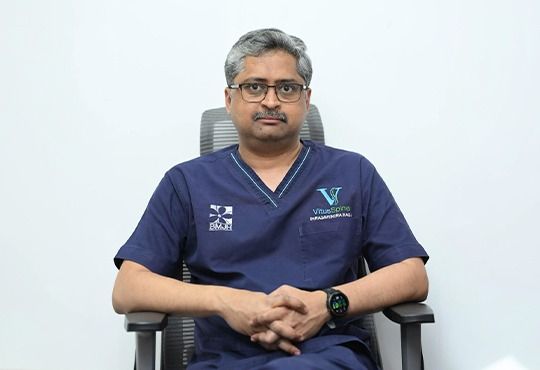
With nearly two decades of experience in spine surgery, Dr Raghavendra Rao Dharmavaram practises in the Department of Spine and Joint Surgery at Bhagwan Mahaveer Jain Hospital, Vasanthnagar, Bangalore. He holds MBBS, MS (Ortho) and AFSA Spine (France) qualifications and is extensively trained in spine surgery in both India and France. He practises across Spine and Joint Surgery and the Pain Clinic, covering the entire range of spine surgeries, from discectomies to complex deformity correction. Numerous publications in national and international peer-reviewed journals reflect his sustained contribution to the field.
Alongside clinical practice, he supports structured training, mentorship and supervised hands-on learning for young surgeons, including through the hospital’s scoliosis project, which offers free surgery to economically disadvantaged children. A strong advocate of learning in the operating theatre, he emphasises sound anatomy knowledge, surgical judgement and the responsible use of navigation and 3D imaging technology. Patient benefit remains the guiding principle, with technology and surgical skill valued only when they serve patients.
In an interaction with M R Yuvatha, Editor, Asia Education Review, Dr Raghavendra, explores how Asia can meet the growing demand for spine care through structured hands-on training, responsible use of navigation and AI technologies, affordable implants and charitable initiatives such as the BMJH Scoliosis Project, so that the region builds better surgeons and not only better hospitals.
Asia has a large and growing population in need of spine care. Longer life expectancy, changing lifestyles and better diagnosis are pushing demand for specialised spine surgery higher every year. Yet access to quality spine education and training remains uneven across the region. For hospitals, medical colleges and healthcare policymakers, the question is no longer only how many spine procedures can be performed, but how many well-trained surgeons are available to perform them safely.
According to Dr Raghavendra at Bhagwan Mahaveer Jain Hospital (BMJH), the future of spine surgery in Asia depends on a combination of education, innovation, accessibility and compassion. The healthcare sector, the specialist points out, must build better surgeons as well as better hospitals and better technology.
The Training Gap in Spine Surgery
Many young surgeons entering the field have solid theoretical knowledge. What they often lack is exposure to complex spinal deformities, advanced surgical techniques and newer technologies. The most significant gap lies between knowing how a procedure is done and actually getting the opportunity to perform it under proper supervision.
Closing that gap calls for structured training programmes, hands-on workshops, mentorship and regular opportunities to work alongside experienced spine surgeons. The goal is to produce surgeons who are technically competent and who also understand when to operate, when not to operate and how to achieve the best possible outcome for each patient.
Why Hands-On Training Matters
Spine surgery is a highly specialised discipline in which practical experience carries enormous weight. Textbooks, lectures and videos alone cannot prepare a surgeon for the demands of the operating room.
A sound training pathway allows young surgeons to observe procedures, practise on simulation models, study surgical anatomy and gradually build skills under the guidance of experienced colleagues. Equally important is exposure to real operating-room situations, including clinical decision-making, handling complications and working within a multidisciplinary team.
BMJH has set out to create such opportunities for younger surgeons, who can observe and participate in complex spine procedures at the hospital.
Charity as a Classroom
One of the hospital's key initiatives is the BMJH Scoliosis Project, a charitable programme that provides free surgery to economically disadvantaged children. Beyond its humanitarian purpose, the project doubles as a learning environment.
Through the programme, younger surgeons gain exposure to spinal deformity correction, advanced instrumentation and the use of modern technology, all under experienced supervision. The model shows how patient service and surgical education can reinforce each other: children who could not otherwise afford treatment receive life-changing care, while the next generation of surgeons learns complex procedures in a supervised setting.
This approach carries a wider lesson for the healthcare industry. Charitable programmes need not be viewed only as community service. When designed well, they can also function as training platforms that strengthen the surgical workforce.
Technology Is Changing the Skill Set
Spine surgery has moved well beyond the days when surgeons depended largely on anatomical landmarks and conventional imaging. Computer-assisted navigation, 3D imaging, robotics and minimally invasive techniques are now making procedures more precise and helping improve patient safety.
BMJH has access to advanced systems such as the O-arm 3D imaging system with intraoperative navigation and neuromonitoring. These tools are particularly valuable in complex spinal deformity surgeries, where accurate implant placement and protection of the spinal cord and nerves are critical.
For young surgeons, this changes what must be learned. Traditional surgical technique remains essential, but so does the ability to use these technologies effectively. At the same time, technology is best seen as a tool in the hands of a skilled surgeon. A thorough understanding of anatomy, sound surgical judgement and clear decision-making will remain fundamental. In short, owning an O-arm, a navigation platform or a neuromonitoring system is important, but developing surgeons who can use them appropriately matters even more.
The Affordability Challenge
Cost remains one of the biggest obstacles in spine care. Advanced implants and sophisticated procedures can be prohibitively expensive for many families, particularly in developing countries such as India.
Addressing the problem requires a multi-pronged approach:
- Price regulation: Reasonable regulation can help prevent excessive pricing of essential implants.
- Insurance and government schemes: Wider insurance coverage and government-funded healthcare programmes can bring specialised spine procedures within reach of more patients.
- Domestic manufacturing: India has the potential to develop cost-effective, high-quality implants without compromising safety, which can reduce dependence on expensive imported products.
- Public-private partnerships: Collaborations can combine government support with the infrastructure and expertise of private hospitals.
The guiding principle, according to the BMJH specialist, is that access to advanced spine surgery should depend on medical need and not on a patient's ability to pay.
Also Read: The Real Skills Gap in Healthcare Management Education
AI, Telemedicine and Digital Rehabilitation
Digital technology is set to play a growing role in how spine conditions are diagnosed, planned and monitored. AI-assisted imaging can help identify spinal abnormalities earlier and support surgeons in analysing complex deformities. Telemedicine can widen access to specialist consultations, especially for patients in remote areas. Digital rehabilitation can help patients continue recovery and exercise programmes after discharge.
For medical colleges and hospitals, this points to a clear training agenda. Young doctors need exposure to digital imaging, computer-assisted surgical planning, navigation systems and the responsible use of artificial intelligence.
Technical skills alone will not be enough, however. Technology must complement clinical judgement rather than replace it, and communication, ethical decision-making, teamwork and an understanding of patients' needs will remain equally important. The aim is to train doctors who are technologically competent without losing the human side of medicine.
Technology without training is incomplete. Navigation, 3D imaging and neuromonitoring systems are valuable, but their impact depends on surgeons trained to use them appropriately.
Advice for Aspiring Spine Surgeons
For young doctors considering a career in spine surgery, the BMJH specialist recommends first building a strong foundation in orthopaedics or neurosurgery before moving into the subspecialty. The path demands years of learning, hard work and continuous improvement.
Motivation matters as well. Spine surgery should not be chosen merely because it involves advanced technology or complex procedures, but because of a genuine interest in solving difficult problems and improving patients' lives. Practical guidance for those starting out includes:
- Seek good mentors.
- Attend workshops and read regularly.
- Treat every opportunity in the operating theatre as a learning experience.
- Stay humble enough to ask questions and disciplined enough to keep learning.
Young surgeons are also encouraged to take part in charitable initiatives. The BMJH Scoliosis Project has shown that such programmes serve two purposes at once: delivering life-changing treatment to children who cannot afford it and giving younger surgeons a chance to learn complex procedures and work with advanced technologies.
Looking Ahead!
The coming of spine surgery in Asia will rest on the ability to bring together education, innovation, accessibility and compassion. Better hospitals and better technology are necessary, but they are not sufficient. As the BMJH specialist puts it, the region must not only build better hospitals and acquire better technology; it must also build better surgeons.
The future is about accessibility, not just sophistication. Asia needs advanced spine centres, but it also needs affordable services and skilled surgeons spread across the region.
🍪 Do you like Cookies?
We use cookies to ensure you get the best experience on our website. Read more...