
-
- Asian universities are transforming climate education by integrating scientific research with social equity, training students to develop practical, community-focused solutions.
- Programs at institutions like NUS, Tsinghua, Seoul National, Chulalongkorn, and the University of Tokyo emphasize hands-on projects, hackathons, and interdisciplinary collaboration to prepare future climate leaders.
- Graduates gain skills in policy, data analysis, stakeholder engagement, and ethical decision-making, positioning them to create sustainable, equitable impact locally, regionally, and globally.
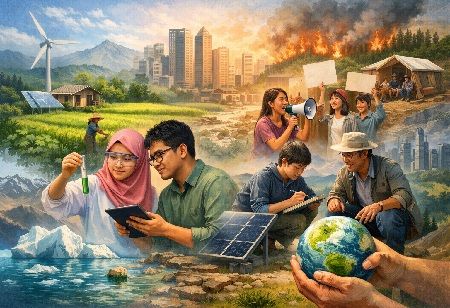
Universities throughout Asia are leading a transformation in the manner in which we educate researchers, combining the scientific study of climate change and the urgent need to promote equity. The academic aspect of these programs has evolved into laboratories for developing real-life solutions to urgent local, regional and global issues. In this new manner of teaching, students are actively participating in projects such as developing low-carbon energy systems to support rural development; creating strategies to adapt to urban heat; and amplifying local voices to the extent possible, while also producing solutions to global and local issues. These projects constitute much more than academic exercises; they are models for how to tackle global problems in an innovative way.
Students will leave their universities with an understanding of climate change; however, they will also receive a unique skillset for converting those scientific statistics into actionable policies, technologies, financing mechanisms and community development efforts that contribute to a sustainable future for the earth and for the communities most affected by climate change. In focusing on these two areas of addressing climate change planet and people most affected Asia is providing a new definition for how to prepare future climate leaders. This innovative effort lays the groundwork for the entire world to follow, that practical, sustainable, equitable solutions to the issues related to climate change are not only feasible, but are currently being implemented.
Why Climate & Equity Education Is Essential for Asia’s Future Researchers
The continent of Asia is facing many of the greatest and most immediate global crises related to our climate; examples include the melting glaciers of the Himalayas and the vulnerable economies of many Pacific nations. However, at this same time, there is great depth of indigenous cultural knowledge throughout Asia that can serve as a source of guidance for living sustainably and resilience. Universities are training researchers to bring together hard statistics with social equity to make sure that everyone is able to participate. Graduates from these programs are providing measurable impact via reductions in emissions while alleviating poverty, creating positive changes in cities and strengthening local economies. This model not only has the impact of aligning with ethics, but also provides a unique competitive advantage for a sustainable future in all countries in the region.
Hands-On Learning for Sustainable Impact
Instead of being strictly academic in nature, the models described here represent an interdisciplinary, problem-solving approach to teaching. Students have the opportunity to explore practical issues through the application of interdisciplinary lessons that link together various subject matters such as climate modeling, development economics and governance in their communities. By using hands-on field research as well as participatory methods, these approaches ensure that equity is at the forefront of all research efforts. Youth innovation challenges and hackathons are designed to help students convert their ideas into working prototypes in a short amount of time by partnering with companies and other industry stakeholders.
As a result of these teaching methods, students develop core competencies to support their research including: advanced methods of data analysis, creating policy, engaging with multiple stakeholders and ethical decision-making. Additionally, through the incorporation of cultural wisdom from Asia’s diverse cultures, students are trained to work collaboratively with the community to create solutions rather than create top-down solutions like many other research methods currently used by researchers worldwide.
Also Read: How Malaysia/Vietnam Are Democratizing Research Education Access
Leading Universities Driving the Transformation
Several Asian universities stand out for their cutting-edge programs, strong research output and commitment to producing equity-minded climate experts:
1. National University of Singapore (NUS)
NUS offers a one-year MSc in Climate Change and Sustainability designed to create the next generation of environmental and industry leaders. Students master climate science, policy and interdisciplinary problem-solving while completing research projects that directly address societal challenges. Graduates are prepared to balance environmental goals with equitable outcomes effectively.2. Tsinghua University (China)
Tsinghua’s Institute of Climate Change and Sustainable Development is a powerhouse for low-carbon transition research. Students gain practical skills through international youth hackathons co-organized with NUS and HKU and participate in global summits that address climate-health intersections. This emphasis on cross-border collaboration and youth innovation equips researchers with tools to create scalable, inclusive solutions.3. Seoul National University (South Korea)
The university offers the Green Leadership Certificate alongside doctoral programs in environmental management and climate-focused studies. Researchers train in carbon-neutral strategies and sustainable landscape design, developing leadership skills that integrate social equity with scientific excellence preparing them to drive regional and national green transitions.4. Chulalongkorn University (Thailand)
The Master’s and PhD programs in Environment, Development and Sustainability (EDS) link climate mitigation and adaptation with poverty reduction, SDGs, business strategy and community resilience. Students emerge with the ability to turn environmental challenges into equitable development opportunities.5. The University of Tokyo (Japan)
Tokyo University’s research clusters explore climate adaptation alongside cultural and social dimensions. Programs build advanced research capabilities in environmental science while emphasizing long-term societal fairness, producing solutions that inspire globally.Also Read: Promising Education Policy Practices for Access & Safety in Asia
Industry Perspectives & Emerging Practices
Leading industry figures articulate succinctly the significance of researcher education focused on the environments and equity, Jacqueline Novogratz, Founder and CEO of Acumen states emphatically, "Everyone has a stake in creating an equitable climate future". She states that researchers educated in both science and issues of social justice will position businesses to invest into solutions that increase dignity and opportunity rather than only reduce emissions. Corporate partners involved in hackathons at Tsinghua University have reported that industry-trained researchers are excellent at creating prototypes of practical tools to use.
Examples of such tools are mobile cooling devices for delivery workers during heat waves and systems designed to protect low-income communities from environmental threats while opening up new market opportunities. Emerging ideas, such as co-created ‘equity innovation labs’ where researchers, businesses and communities co-develop low carbon business models are becoming more popular. Another method is embedding university graduates directly into the sustainability teams of corporations through a fellowship-type program, thereby guaranteeing that the research done translates to real-world applications and creates a speedier transition to a just world.
Fresh Ideas Shaping Tomorrow’s Researchers
Asian universities are pioneering approaches that are genuinely new and impactful:
- Cultural-tech fusion research- integrating traditional ecological knowledge, such as indigenous water management or disaster folklore, with AI and data tools for equitable adaptation.
- Just-transition skill pathways- modules that train researchers to design climate policies creating jobs while protecting livelihoods in high-emission sectors.
- Youth-led impact prototyping- hackathon-style programs turn masters and PhD students into entrepreneurs who launch community-scale solutions while still in school.
- Cross-border equity networks- collaborative platforms, such as Tsinghua-NUS partnerships, allow researchers to address regional challenges like Mekong basin justice or Himalayan resilience together.
These methods produce graduates ready for high-demand roles in international organizations, green startups, impact funds and government agencies, offering meaningful and lucrative careers.
Conclusion
Asian institutions have taken the lead in producing a new generation of climate-focused researchers who have both a global and local approach and produce results that positively affect everyone. These new initiatives are available for students wanting to explore opportunities, business leaders looking for talent and policy-makers who want to develop educational strategies. The time is now to begin engaging with these initiatives. In addition to being long-lasting, the future will be just and equitable, have many creative solutions and will be led proudly by Asia. The researchers being trained today will be responsible for creating real outcomes across the region and around the world through the attainment of critical climate goals.
🍪 Do you like Cookies?
We use cookies to ensure you get the best experience on our website. Read more...