
-
Dubai Chambers has signed a cooperation agreement with the University of Toronto to introduce a specialised executive education programme on Agentic Artificial Intelligence (AI) for family business leaders in Dubai. Delivered by the university's Rotman School of Management, the programme aims to equip current and next-generation family business leaders with the knowledge and practical skills to apply agentic AI in business operations, improve efficiency, strengthen competitiveness and support continuity across generations.
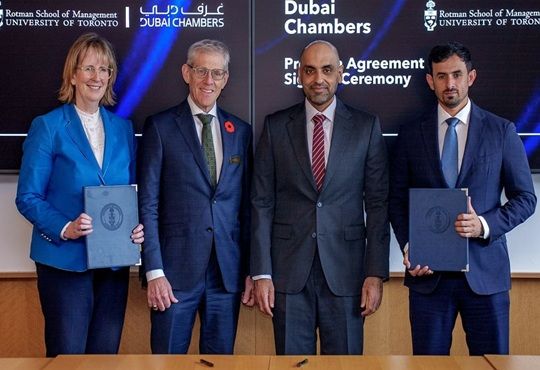
The agreement was signed during a visit to Canada by a Dubai Chambers delegation led by Mohammad Ali Rashed Lootah, President and CEO of Dubai Chambers. Salem Al Shamsi, Executive Vice President of International Relations at Dubai Chambers, and Joseph Milner, Professor and Interim Dean representing the Rotman School of Management, signed the agreement.
Lootah said agentic AI offers a strategic opportunity for family businesses in Dubai to improve productivity, develop business models and identify new growth opportunities. He highlighted the technology's potential to strengthen decision-making, improve operational processes, preserve institutional knowledge and facilitate its transfer between generations while maintaining the values that support family business success.
He added that Dubai Chambers aims to equip family business leaders and emerging generations with the knowledge and practical capabilities required to lead technological transformation in line with their organisations' long-term priorities. He also noted that the partnership with the Rotman School of Management reflects the organisation's commitment to expanding international knowledge collaborations and developing business leaders who can translate the potential of agentic AI into practical business applications.
Joseph Milner said the collaboration would help family business leaders explore how emerging AI technologies can support innovation, improve competitiveness and strengthen the long-term prospects of their businesses across generations. He also described the initiative as a foundation for broader cooperation with Dubai Chambers in the UAE and internationally.
Under the agreement, the Dubai Centre for Family Businesses, which operates under Dubai Chambers, will work with the Rotman School of Management to deliver the Agentic AI for Family Business Leaders programme. It is designed for existing family business leaders and members of the next generation preparing to take on leadership responsibilities within their family enterprises.
The executive education programme will focus on aligning AI applications with the strategic priorities of family businesses. Its learning objectives include supporting sustainable business growth, strengthening governance practices, facilitating the transfer of institutional knowledge between generations and preparing future leaders to manage technology-driven organisational changes.
The programme will be delivered in two parts, combining classroom learning in Dubai with practical exposure in Toronto. The first component will feature in-person sessions in Dubai, incorporating interactive discussions, case studies and practical workshops. These activities will introduce participants to the strategic and operational applications of agentic AI and help them assess how the technology can address challenges within their businesses.
The second component will involve three days of company visits and experiential learning in Toronto. Participants will gain first-hand insights into how organisations develop, implement and govern agentic AI solutions. The visits are also intended to help participants understand practical approaches to integrating AI into business operations and apply relevant lessons to their own organisations.
The curriculum will cover five core modules: AI Strategy and Organisational Transformation; Understanding Agentic AI and Unlocking Business Value; Designing High-Value Agentic AI Use Cases; From Use Case to Action: Implementing Agentic AI; and Company Visits and Experiential Learning.
A key focus of the programme will be the specific requirements of family-owned enterprises, particularly the need to adopt emerging technologies while preserving family values, organisational culture and business identity. The sessions will also address data confidentiality, trust, governance and business continuity, helping participants understand the considerations involved in introducing AI into established family enterprises.
Also Read: Beyond Technology: Why Asia Needs Stronger Spine Surgeon Education
Participants will learn to evaluate potential agentic AI applications based on their expected business impact, feasibility, scalability and associated risks. This approach is intended to help business leaders identify opportunities where AI can deliver practical value while ensuring that technology adoption remains aligned with organisational priorities.
Throughout the programme, participants will develop practical use cases based on real challenges and opportunities within their respective businesses. The learning process will culminate in implementation roadmaps outlining strategic priorities, organisational readiness requirements, governance frameworks and methods for measuring business impact.
The company visits in Toronto will provide an additional opportunity to refine these roadmaps by examining the experiences of organisations already integrating AI into their operations.
Through this collaboration, Dubai Chambers and the University of Toronto aim to strengthen executive education opportunities for family business leaders, supporting their ability to understand and adopt emerging technologies while preparing their enterprises for long-term growth and intergenerational continuity
🍪 Do you like Cookies?
We use cookies to ensure you get the best experience on our website. Read more...