Turkmen State Architecture And Construction Institute: A National Hub For Advanced Engineering & Architectural Innovation

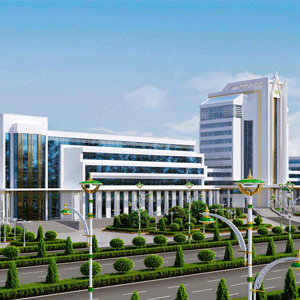
Turkmen State Architecture And Construction Institute
In a world where knowledge shapes progress, fostering international cooperation in science and education has become essential for empowering students with global exposure, advanced learning opportunities, and future-ready skills, creating pathways to institutions that champion these values and help young minds thrive in an interconnected academic landscape.
Among such institutions, one standout example is the Turkmen State Architecture and Construction Institute, a modern center of learning that has rapidly become a pillar of engineering and construction education in Turkmenistan. Established on May 25, 2012, on the foundation of the former Turkmen Polytechnic Institute, the institution began its operations in 1963.
The institute carries forward a legacy of scientific rigor while embracing contemporary technological and industrial advancements. Its distinctiveness lies in its strong alignment with national development goals, its breadth of specialized programs, and its commitment to merging theoretical knowledge with industrial realities.
“Our goal is to train specialists who can both imagine and build the future of Turkmenistan”, emphasizes Mammedov Batyr Meretdurdyyevich, Rector, Candidate of Technical Sciences, Turkmen State Architecture and Construction Institute.
A Legacy Evolving Into Modern Excellence
The transformation of the Turkmen Polytechnic Institute into the Turkmen State Architecture and Construction Institute marked a strategic shift in the nation’s higher-education landscape. It was meant to become a more consolidated and up-to-date scientific and design institution that could bring up specialists for the Ministries and Departments involved in the construction and industrial development of the country.
Since then, the structure of the Institute has grown to eight faculties and 28 departments, training over 4,600 students in 34 specializations and offering a bachelor's degree course in 13 major fields. Recent academic developments include the addition of a new master's degree course in Information Systems and Technologies, reflecting the commitment of the institution to digital transformation.
That is why the Institute stands out through its comprehensive academic ecosystem in the areas of architecture, construction engineering, chemical technology, informatics, power engineering, communication systems, materials technology, economics, management, and digitalization.
Each program is modernly tailored to meet today's industry needs, with curricula shaped not only by national priorities but also by continuous changes in technology. This strong basis is further complemented by a scientific investigation culture.
Students and teachers take part in design-oriented research: Young Architect, Young Road Constructor, and Young Chemist Academic Circles allow them to create independent ideas, work on applied scientific tasks, and engage in project workteam activities. Integration of research and practice is one of the main hallmarks of the Institute, which allows learners to turn theory into meaningful solutions for urban development, infrastructure, and industrial innovation.
Strengthening Infrastructure for Modern Learning
The Institute’s academic landscape is supported by a dedicated campus comprising six faculty buildings equipped with modern classrooms and computer facilities. A key component of its practical training system is the Turkmen-Indian Training and Production Center, a specialized workshop furnished with advanced machinery for ferrous and non-ferrous metal processing. This facility provides essential hands-on learning for students, especially those studying mechanical engineering.
While the current laboratory infrastructure is sound, the Institute is about to take a serious leap forward with the construction of a new, state-of-the-art campus. The construction was officially launched by the President of Turkmenistan on 1 September 2023, and is due to be completed by 2026. This complex will introduce modern labs featuring industry-standard equipment and innovative digital tools from global technology leaders.
The other critical pillar of institutional growth is faculty development. A well-structured Faculty of Advanced Training provides regular professional development for both teaching staff and industry personnel, enhancing academic quality to ensure closer collaboration with government agencies and private enterprises. Industry-linked learning is even more strongly highlighted in the curriculum through obligatory design, industrial, and pre-diploma internships carried out throughout the country.
Digital transformation in teaching and learning processes has taken center stage at the Institute. The students are exposed to BIM systems, 2D and 3D modeling software, and VR/AR-based construction safety simulations that guarantee modern technological architectural and engineering environments for which the graduates will be going out into. The internal network and the Educational Portal with access to e-textbooks, academic content, and video materials support this approach to digital education.
Education is the foundation upon which we build progress, and our mission is to shape specialists who can lead the future with knowledge, skills, and innovation‘‘‚‚
Future Vision
The Turkmen State Architecture and Construction Institute aims to deepen its global integration and technological advancement. Key activities include the creation of an industry sandbox for fast digital experimentation in construction and energy facilities, and the innovative Six plus Six program that merges intensive training in AI, analytics, and cybersecurity with hands-on industrial practice.
The Institute continues to grow its international partnerships, in addition to its current collaboration with universities in Russia, Italy, Belarus, the USA, Romania, and Kyrgyzstan. It is already included in several Times Higher Education rankings, reflecting a rising global profile and a commitment to excellence. Guided by a forward-looking vision, the Institute aims to become one of the leading regional centers of innovation, engineering education, and international cooperation.
Current Magazine
.jpg "Engineering The Future, Empowering The Asian Youth")
Editor's Column
10 Educational, Sports...
M R Yuvatha, Editor, Asia Education Review

Top High-Paying Jobs...
M R Yuvatha, Editor, Asia Education Review

How Asia Built the...
M R Yuvatha, Editor, Asia Education Review

10 Career Fairs:...
M R Yuvatha, Senior Correspondent, Asia...
Editor's Guest Post

The Future of Learning: Building...
Lolitta Suffian, Senior Vice President of Customer Experience, Bank...

The Real Skills Gap in...
Dr Edyta Skibinska, Public Health Educator, Researcher & Founder,...
Preparing Students for Business...
Dr Deepak Bajaj, Academic & Campus Director, Deakin University GIFT...
🍪 Do you like Cookies?
We use cookies to ensure you get the best experience on our website. Read more...