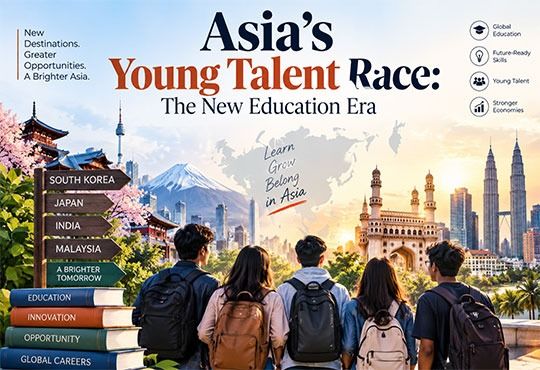
Asia's Young Talent Race: The New Education Era

-
Universities and governments are no longer competing only for rankings, research funding or tuition revenue. Increasingly, they are competing for something far more valuable young talent capable of driving the next generation of economic growth.
Across Asia, countries are strengthening universities, expanding international programmes, attracting overseas institutions and creating new opportunities for international students.
The competition is becoming especially interesting because students now have more choices within the region itself.
South Korea, Japan, China, Malaysia, Singapore, Hong Kong and India are developing different strategies to attract students, researchers and future professionals.
Recent developments show that this is no longer a small shift. Asian destinations are raising international-student ambitions while students increasingly consider destinations closer to home.
The result is a new question for the education sector :
Which Asian destinations will succeed in attracting and retaining the young talent that will shape the region's future?
Education Is Becoming a Talent Strategy

For years, students from Asia often looked toward the United States, United Kingdom, Canada and Australia when considering international education.
Those destinations remain important. But the Asian education market is becoming increasingly competitive in its own right.
Students are now considering factors such as:
- University quality
- Tuition fees
- Cost of living
- Scholarships
- Employment opportunities
- Research facilities
- International recognition
- Industry connections
- Post-study opportunities
- Cultural and geographical proximity
This is creating opportunities for Asian countries to position themselves as both education destinations and talent ecosystems.
The competition is therefore moving beyond the classroom.
A country that attracts a student can potentially gain a future researcher, entrepreneur, engineer, technology professional or business leader.
That makes international education a long-term economic strategy.
 Where the Competition Is Taking Shape
The race for Asia's young talent is already taking shape across different countries and education hubs.
South Korea is using its growing global influence and cultural popularity to attract international students.
Japan is combining its academic and research strengths with international scholarship and talent programmes.
India is increasingly bringing international education opportunities directly into its major cities.
Malaysia is strengthening its position as a regional education hub.
Other destinations, including Singapore, China and Hong Kong, are also expanding their international education ambitions.
In the sections ahead, we look at the major Asian education destinations competing for young talent, the strategies they are using and why this competition could become increasingly important for the region's economy.
South Korea: Turning Global Popularity Into Education Power

South Korea has something many countries would like to have: a powerful global cultural identity.
Korean music, television, film, technology and consumer brands have created international interest in the country.
That cultural influence is increasingly becoming an advantage for education.
South Korea has been expanding its efforts to attract international students and strengthen its position as an international education destination.
The country's international student population has grown substantially, and recent reporting indicates that South Korea has already reached its target of 300,000 international students ahead of schedule.
The government is also using Korean Education Centers and Study in Korea fairs to provide international students with information about education opportunities.
Lee Nan-young, Director General of the International Education Planning Bureau at South Korea's Ministry of Education, described the relationship between Korea's global influence and international education:
“As Korea’s global stature rises and the influence of the Korean Wave continues, interest in studying in Korea is also increasing. I look forward to the Korean Education Centers evolving into strategic bases for attracting international students by serving as public study-abroad platforms that provide systematic and comprehensive information on studying in Korea.” — Lee Nan-young, Director General, International Education Planning Bureau, Ministry of Education, South Korea
The strategy is significant because South Korea is not treating international education as an isolated university activity.
It is connecting culture, education, international recruitment and talent development.
For the next generation of students, that combination could make South Korea an increasingly attractive destination.
 Japan: Combining Education With Future Workforce Needs
Japan represents another important part of Asia's talent competition.
Its universities and research institutions are supported by a strong ecosystem in technology, engineering, manufacturing and scientific research.
Japan is also strengthening international education programmes and scholarship opportunities.
Its geographical position within Asia gives it another advantage. Students from neighbouring countries can access a major global economy while remaining relatively close to their home markets.
The country's international student numbers have also grown strongly, with recent reporting indicating that Japan crossed its previous international-student target years ahead of schedule.
But Japan's interest in international students is not simply about increasing university enrolment.
The country faces demographic pressures and an ageing population.
That makes young international graduates potentially valuable to both universities and employers.
The opportunity is therefore much larger than tuition.
If students study, develop skills, enter Japanese industries and eventually build professional connections across Asia, education becomes part of a broader talent pipeline.
India: Hyderabad's Global Education Ambition

India brings a different model to the competition.
Instead of focusing only on sending Indian students overseas, Indian cities are increasingly attempting to bring global education opportunities into the country.
Hyderabad is one of the most visible examples.
Telangana Chief Minister A. Revanth Reddy has promoted the vision of transforming Hyderabad into a Global Knowledge Hub, with international universities exploring campuses, programmes, research partnerships and executive education.
The University of London and Northeastern University are set to establish offshore campuses in Hyderabad, while other major institutions have been involved in discussions around programmes, research and partnerships.
This could give students access to international academic opportunities without necessarily requiring them to leave India.
Revanth Reddy highlighted the importance of education and skills for Telangana's young population:
“I wish to share my sense of pride and happiness with the people of Telangana, especially youth, that our vision to create a Global Knowledge Hub in Hyderabad has been endorsed, supported and will be partnered with the world’s greatest educational institutions. My biggest passion and contribution to youth will be skills, sports and education, making them highly qualified for any global challenge.” — A. Revanth Reddy, Chief Minister of Telangana
He also described the broader ambition:
“These pioneering efforts will make Hyderabad a global educational powerhouse.”
The developments are significant because Hyderabad already has strong connections with technology, pharmaceuticals, life sciences, research and multinational companies.
Connecting those industries with international universities could create a stronger education-to-employment pipeline.
 Malaysia: Building a Regional Education Hub
Malaysia has another advantage in the Asian education competition a regional connectivity.
Its location makes it accessible to students from across Southeast Asia and beyond.
The country has been working to strengthen its position as an international higher education destination while balancing internationalisation with domestic workforce requirements.
Affordability, English-language programmes, international partnerships and regional access can all contribute to Malaysia's attractiveness.
But the bigger opportunity lies in developing talent that can operate across borders.
Students who study in Malaysia can potentially build connections with companies and institutions across Southeast Asia, giving the country a role as a regional bridge between education and employment.
This makes Malaysia an important part of the wider Asian talent landscape.
Also Read : Top Skills Asian Students Need for Jobs in 2026
The Competition Is About More Than University Seats
The most important change in Asian education is that countries are increasingly competing on the complete student experience.
A student may ask:
“Where can I get the best degree?”
But increasingly, the question becomes:
“Where can I build the best future?”
That includes education, internships, research, professional networks, career opportunities and the possibility of remaining connected to the local economy after graduation.
This is why international student recruitment is becoming increasingly strategic across Asia.
Recent reporting shows that several Asian destinations are expanding international student targets at a time when traditional English-speaking destinations are dealing with tighter enrolment and immigration policies.
Each Asian destination is competing from a different position.
South Korea is leveraging cultural influence and technology, Japan is connecting education with research and workforce needs, India is bringing global universities closer to its huge student population, while Malaysia is building an accessible regional education hub.
Together, these models show how competition for young talent is reshaping Asian education.
From International Students to Skilled Talent

Attracting students is only the first stage.
The bigger challenge is retaining talent.
A student who arrives in Asia for a degree can eventually become:
- A technology professional
- An entrepreneur
- A researcher
- An engineer
- A healthcare professional
- A consultant
- A business leader
- A specialist in an emerging industry
That means universities can become entry points into a much larger economic ecosystem.
For countries facing ageing populations or shortages in specialised skills, international graduates can become an important part of future workforce planning.
This is why the Asian education race is increasingly connected to employment, immigration policy, innovation and economic growth.
International University Campuses Could Change the Game

Another major development is the expansion of international university campuses.
Instead of requiring every student to travel overseas, universities can increasingly establish a physical presence in major Asian cities.
Hyderabad provides a strong example of this approach.
The planned University of London and Northeastern University campuses demonstrate how international institutions can become part of a city's education and economic strategy.
This model could become more common across Asia.
Students may increasingly be able to receive international qualifications, interact with global faculty and connect with multinational companies while remaining in their home country.
That could fundamentally change the traditional overseas education model.
Technology Is Creating a New Talent Race
Artificial intelligence is adding another layer to the competition.
The jobs of the future will require skills in areas such as:
- Artificial intelligence
- Data science
- Cybersecurity
- Robotics
- Biotechnology
- Advanced engineering
- Digital business
- Semiconductor technology
Asian economies already have significant positions in several of these sectors.
Universities that can connect education with emerging industries could therefore become particularly attractive to students.
The strongest education hubs may not simply be the places with the best universities.
They could be the places where universities, companies, governments and technology ecosystems work together.
Why Young Talent Is So Valuable
Asia's enormous population gives the region a major potential advantage.
But population alone is not enough.
Countries need educated, skilled and adaptable people who can contribute to changing economies.
Young talent can create businesses, develop technology, conduct research and strengthen industries.
That makes education a strategic investment.
The real economic value of international education therefore extends far beyond tuition fees.
It includes the value of the people, ideas, companies and innovations that education can produce.
That is the deeper meaning behind the billion-dollar race.
 There May Not Be One Winner
The Asian education competition is unlikely to produce one single winner.
Different countries have different advantages.
South Korea has global cultural influence, technology and a rapidly expanding international education strategy.
Japan combines research, technology, industrial strength and international education programmes.
India has enormous student demand and is increasingly attracting global universities into its major cities.
Malaysia has regional connectivity and an expanding international education ecosystem.
China, Singapore and Hong Kong also remain important players in Asia's higher education landscape. Recent developments indicate that these destinations are continuing to strengthen their international recruitment strategies.
The result could be a much more diverse Asian education market.
The Future of Asia's Young Talent
The biggest question is no longer simply:
Where will Asian students study?
It is :
Where will Asia's young talent choose to build its future?
That distinction matters.
Universities want students.
Governments want skilled workers.
Companies want specialised talent.
Cities want innovation.
And young people want education that leads to meaningful careers.
When these interests come together, education becomes much more than an academic sector.
It becomes an economic strategy.
The countries and cities that can successfully combine high-quality education, global partnerships, technology, affordability and career opportunities could gain a significant advantage in the years ahead.
Asia's education race is therefore not simply a competition between universities.
It is a competition between entire talent ecosystems.
And as young people gain more choices within the region, the countries that succeed will be those that offer not only a place to study — but a compelling reason to stay, work, innovate and build the future.
🍪 Do you like Cookies?
We use cookies to ensure you get the best experience on our website. Read more...